
Every factory floor generates airborne hazards — from sub-micron oil mist in CNC machining cells to welding fumes laced with hexavalent chromium. Left uncontrolled, these contaminants threaten respiratory health, degrade equipment, and put operations on the wrong side of regulatory limits. This guide breaks down the most effective industrial air filtration solutions available today, explains how each technology works, and shows you how to match the right system to your facility's specific challenges.
Why Factory Air Quality Is a Strategic Priority
Industrial facilities generate significant volumes of dust, smoke, and chemical aerosols that degrade indoor air quality when left unchecked. According to the World Health Organization, air pollution ranks among the biggest environmental threats to human health — a reality that extends to the factory floor. Prolonged exposure to airborne contaminants can cause respiratory disease, occupational asthma, skin irritation, and in severe cases, cancer.
Beyond health, poor air quality damages sensitive equipment, compromises product integrity in sectors like electronics and pharmaceuticals, and exposes companies to regulatory penalties. Investing in effective filtration is therefore not just a compliance exercise — it delivers measurable returns through energy savings, longer equipment life, higher productivity, and a smaller environmental footprint.
Understanding the Contaminant Landscape
Before selecting a filtration system, you need to identify exactly what you are filtering. Industrial airborne pollutants generally fall into three categories:
- Particulate matter (dust and swarf): Generated during grinding, woodworking, powder handling, and material cutting.
- Mist and aerosols: Oil mist and coolant mist produced by CNC machining, cold heading, and metalworking operations.
- Fumes and gases: Welding fumes containing hexavalent chromium and manganese, VOCs from coatings, and chemical vapors from processing.
Each category demands a different filtration approach — and in many facilities, multiple contaminant types are present simultaneously.
The Six Core Industrial Air Filtration Technologies
1. Dust Collectors
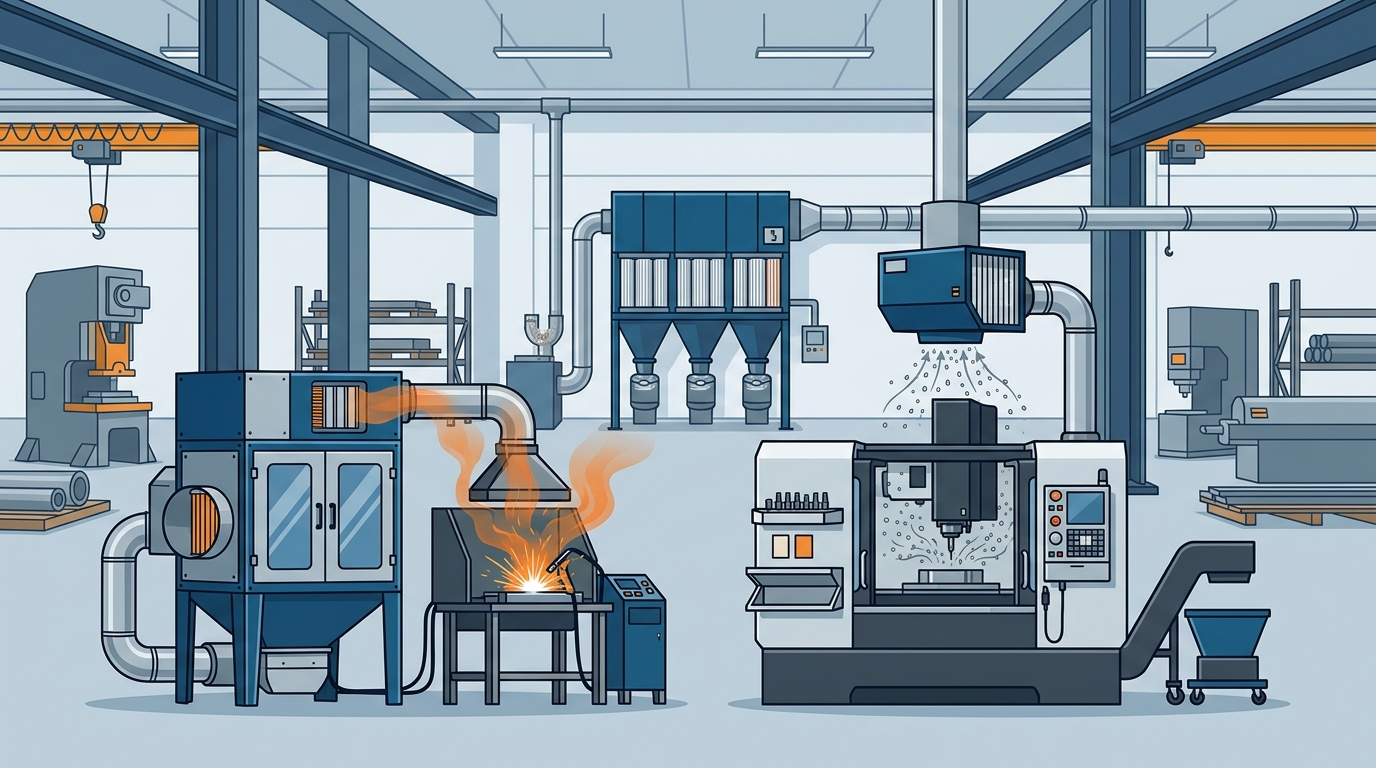
Dust collectors are among the most common solutions in industrial environments. These systems pull contaminated air through specialized filters, trapping solid particles while releasing cleaned air back into the space. They are essential in industries like woodworking, metal grinding, and powder handling where large volumes of dry particulate are generated.
Two dominant sub-types exist:
- Baghouse collectors: Use fabric filter bags and provide long service life, consistent performance, and adaptability to a wide range of dust types. In many plants, baghouses form the backbone of solid particulate removal.
- Cartridge collectors: Feature a pleated design that maximizes surface area, improving efficiency and extending filter life. Their compact footprint makes them ideal for facilities with limited floor space, and they are frequently deployed in welding fume collection, powder coating, and pharmaceutical operations.
2. Mist Collectors
Mist collectors are purpose-built for environments where oil mist, coolant mist, or water-soluble aerosols are the primary concern — most commonly CNC machining, turning, and cold heading operations. Within precision manufacturing environments, mist collectors are essential for protecting both workers and sensitive production equipment from airborne oil particles and residue.
Modern mist collectors use progressive multi-stage filtration to achieve exceptional capture rates. Aeroex's ARO Series, for example, employs a four-stage process:
- Mechanical element: Separates up to 90% of oil mist and swarf using smooth metal surfaces that drain fluid back to the machine sump.
- MERV 13 depth-loading fibrebed filter: Outperforms thin competitors with a thick composition that minimizes blockage.
- MERV 14 fibrebed filter: Offers 25 times more surface area than standard filters.
- Certified HEPA filter: Captures 99.97% of sub-micron particles including mist and smoke.
This progressive approach removes 95% of mist particles in the very first stage, which dramatically extends the life of downstream filters and reduces total maintenance costs. ARO filters feature mechanical elements lasting up to 20 years, agglomerator filters lasting 10–15 years, and HEPA filters lasting 2–4 years.
For space-constrained shops, the Aeroex Mist-Fit line delivers high-performance mist collection in a compact, direct-mount design with a MERV 15-rated fibrebed filter, optional HEPA filtration that removes up to 99.97% of sub-micron particles, and optional electrical kits for automated operation and safety interlocks.
3. Fume Extractors
Fume extractors are designed to capture gases, smoke, and fine particulate matter produced during processes like welding or soldering. They typically use extraction arms, downdraft tables, or portable extraction hoods to collect fumes at the point of generation before contaminants spread throughout the facility.
High-performance welding extractors integrate advanced technologies such as high-efficiency filters, automated monitoring systems, and strategically placed capture points. Source capture at the weld is critical because ambient systems alone cannot replace direct fume extraction — the two strategies work best together.
4. Wet Scrubbers
Wet scrubbers use a scrubbing liquid — typically water or a neutralizing chemical agent — to remove both particulates and gaseous pollutants from exhaust streams. They are particularly effective in chemical processing, metal finishing, and any application where sticky or hygroscopic particles make dry filtration impractical.
5. Ambient Air Filtration Systems
Ambient systems continuously circulate and filter the general plant air rather than targeting a single emission source. They reduce overall contamination levels across the entire facility and are often ceiling-mounted for optimal air circulation.
Aeroex's Iris-2000 is a ceiling-mounted ambient capture system equipped with HEPA and activated carbon filters capable of capturing a wide range of contaminants from dust and allergens to VOCs and odors. It features intelligent sensors that monitor air quality in real time and adjust filtration levels automatically, all while operating silently and energy-efficiently.
6. Hybrid and Multi-Stage Systems
Hybrid systems combine multiple filtration technologies — such as mechanical separation, electrostatic precipitation, and chemical adsorption — to achieve higher collection efficiency and extended service life. By integrating stages of particulate and gas-phase filtration, hybrid designs deliver superior performance, lower operating costs, and enhanced adaptability for complex exhaust streams where a single technology cannot address every contaminant.
Source Capture vs. Ambient Capture: Choosing a Strategy
Most effective factory filtration programs layer two complementary strategies:
| Strategy | How It Works | Best For |
|---|---|---|
| Source Capture | Extracts contaminants directly at the machine or process using extraction arms, hoods, or direct-mount collectors | High-concentration emissions (welding, CNC machining, grinding) |
| Ambient Capture | Filters the general plant atmosphere continuously from a central or ceiling-mounted unit | Background contamination, residual mist, facility-wide odor control |
Portable filtration units add a third option — mobile extractors that can be repositioned as needed, providing localized fume extraction wherever work is being performed. This adaptability makes them an excellent choice for workshops and production lines where tasks vary frequently.
Regulatory Compliance: OSHA and Beyond
Organizations like OSHA set permissible exposure limits for various airborne contaminants including dust, fumes, and chemicals. Exposure to these contaminants can lead to respiratory diseases, skin irritation, and long-term conditions like occupational asthma or cancer. To stay compliant and avoid penalties, industrial operators must implement effective engineering controls — with air filtration being the most critical.
Implementing robust filtration systems helps facilities:
- Reduce particulate concentrations below permissible exposure limits (PELs)
- Meet EPA emissions standards for outdoor discharge
- Satisfy ISO and EU directive requirements for international operations
- Qualify for environmental incentives or green certifications in some jurisdictions
How to Select the Right System for Your Factory
There is no one-size-fits-all solution — the filtration system must be tailored to the specific contaminants, process conditions, and facility layout. Follow this decision framework:
- Identify your contaminants: Are you dealing with dry dust, oil mist, welding fumes, chemical vapors, or a combination? Different pollutants require different filter media and capture strategies.
- Assess particle size and concentration: Fine sub-micron mist demands HEPA-grade filtration, while coarse dust may only need a baghouse or cartridge collector.
- Evaluate facility layout: Ceiling height, machine spacing, and ductwork access all influence whether source capture, ambient capture, or a hybrid approach is most practical.
- Factor in process temperature and chemistry: Systems like the Aeroex ARO Series handle temperatures up to 70 °C and pH levels from 5.8 to 12, but not every collector can tolerate these conditions.
- Calculate total cost of ownership: Look beyond purchase price to filter lifespan, energy consumption, maintenance labour, and downtime. Systems with long-life filters — such as mechanical elements lasting up to 20 years — deliver significantly lower lifecycle costs.
- Plan for growth: Anticipate future expansion needs so your filtration infrastructure can scale with your operations.
Real-World Impact: What Clean Air Delivers
Clean air improves employee morale, reduces sick leave, and demonstrates a company's commitment to corporate social responsibility. Beyond human factors, effective filtration protects sensitive equipment from oil residue and dust accumulation, extending machine life and reducing unplanned maintenance.
In industries like pharmaceuticals and electronics manufacturing, even the smallest airborne particle can compromise a product batch — making filtration a direct contributor to quality assurance and yield.
Emerging Trends in Industrial Air Filtration
- Smart sensor integration: Systems now use real-time air quality sensors to automatically adjust airflow and filtration intensity, optimizing performance while minimizing energy costs.
- IoT-ready platforms: Connected filtration units enable remote monitoring, predictive maintenance alerts, and usage data tracking for smarter facility management.
- Energy-efficient designs: Variable frequency drives (VFDs) and optimized airflow engineering substantially extend filter life and cut power consumption.
- Carbon and molecular filtration: Activated carbon filters are being integrated alongside mechanical filters to address VOCs, odors, and gaseous pollutants in a single system. Aeroex systems utilize advanced carbon filters to capture and neutralize odors by adsorbing airborne chemical compounds.
Key Takeaways
- Factory air quality is both a safety obligation and a strategic advantage — cleaner air means healthier workers, longer-lasting equipment, and fewer compliance risks.
- The six core filtration technologies — dust collectors, mist collectors, fume extractors, wet scrubbers, ambient systems, and hybrid units — each address different contaminant profiles.
- Multi-stage progressive filtration, such as the four-stage process in the Aeroex ARO Series, maximizes capture efficiency while extending filter life and reducing total cost of ownership.
- Effective programs layer source capture with ambient capture to address both concentrated emissions and background contamination.
- Smart sensors, IoT connectivity, and energy-efficient engineering are transforming filtration from static hardware into intelligent air quality management systems.
Frequently Asked Questions
What are the main types of industrial air filtration systems used in factories?
The most widely used systems include dust collectors (baghouse and cartridge types), mist collectors, fume extractors, wet scrubbers, ambient air filtration systems, and hybrid multi-stage units. The best choice depends on the type of contaminants your processes generate, particle size, and facility constraints.
How do multi-stage filtration systems improve air quality?
Multi-stage systems pass contaminated air through progressively finer filter media — from coarse mechanical separators to certified HEPA filters. Each stage removes a specific particle size range, which protects downstream filters, extends overall filter life, and achieves capture rates up to 99.97% for sub-micron particles.
What OSHA regulations apply to factory air quality?
OSHA establishes permissible exposure limits (PELs) for a wide range of airborne contaminants. Facilities must implement engineering controls — primarily air filtration and ventilation — to keep worker exposure below these thresholds. Non-compliance can result in fines, shutdowns, and increased liability.
What is the difference between source capture and ambient capture filtration?
Source capture systems extract contaminants directly at the emission point (e.g., an extraction arm at a welding station), while ambient capture systems filter the general plant atmosphere from a centralized position. Most well-designed facilities use both in combination for comprehensive air quality control.
How long do industrial air filters typically last?
Lifespan varies dramatically by technology and application. Aeroex ARO mist collectors, for instance, feature mechanical elements lasting up to 20 years, agglomerator filters lasting 10–15 years, and HEPA filters lasting 2–4 years. Baghouse filter bags and cartridge elements typically last 1–3 years depending on dust loading and maintenance practices.
Can a single filtration system handle multiple contaminant types?
Yes. Hybrid and multi-stage systems combine mechanical, HEPA, and activated carbon filtration to address particles, mist, gases, and odors simultaneously. Aeroex's engineered solutions, for example, integrate carbon filtration for VOC and odor removal alongside mechanical and HEPA stages for particulate capture.