

Choosing the right industrial air filtration system is one of the most consequential decisions a facility manager or plant engineer will make. The wrong choice leads to regulatory citations, worker health problems, equipment degradation, and wasted capital. The right choice delivers measurable improvements in safety, productivity, and long-term operating costs.
This guide walks you through every factor that matters—from identifying what is in your air to matching the correct technology, sizing the system, meeting compliance thresholds, and evaluating total cost of ownership.
Why Industrial Air Filtration Is Non-Negotiable in Manufacturing
Manufacturing processes generate airborne contaminants at concentrations far exceeding those found in commercial or residential settings. Welding, CNC machining, grinding, painting, laser cutting, and 3D printing all release harmful smoke, mist, fumes, or dust into the plant atmosphere. Left unchecked, these pollutants create cascading problems.
- Worker health: Exposure to industrial air pollution can cause respiratory problems, cardiovascular disease, and even cancer. This is why air purification is essential in industrial settings.
- Equipment damage: Dust and oil mist accumulate inside machinery, causing reduced efficiency, increased wear, frequent breakdowns, and higher maintenance costs.
- Regulatory risk: OSHA requires manufacturing facilities to maintain safe working environments free from hazards that could cause harm or injury. Respiratory Protection (29 CFR 1910.134) ranked as the number-four most frequently cited OSHA standard in 2024, with 2,470 violations.
- Product quality: Airborne contaminants can cross-contaminate manufactured products, leading to recalls and liability.
Step 1: Identify Your Contaminants and Particle Size
Before evaluating any equipment, you must characterize the specific airborne pollutants in your facility. Air quality challenges can differ vastly across the manufacturing floor depending on the applications being used, and those applications will vary from one industry to the next.
Common contaminant categories
| Contaminant Type | Common Sources | Typical Particle Size |
|---|---|---|
| Oil and coolant mist | CNC machining, metalworking, cold heading | 0.5–5 µm |
| Welding fume | MIG, TIG, stick welding, robotic cells | 0.01–1 µm |
| Dust (wood, metal, mineral) | Grinding, sanding, woodworking, aggregate handling | 1–100 µm |
| Chemical vapours and VOCs | Painting, coating, adhesives, plastics processing | Molecular (gas-phase) |
| Smoke | Combustion engines, laser cutting, soldering | 0.01–2.5 µm |
The smaller the particle, the more advanced filtration you need. Large dust particles may require pre-filters, fine particles may need high-efficiency filters, and chemical vapours may require activated carbon filtration. Understanding this hierarchy is the first step toward an effective system design.
Step 2: Understand Filtration Efficiency Ratings
Filtration efficiency is typically expressed as a percentage indicating the proportion of targeted particles the filter successfully removes from the air. Two rating systems dominate industrial air filtration decisions.
MERV ratings
MERV stands for Minimum Efficiency Reporting Value. The scale was developed by ASHRAE to measure the effectiveness of air filters. MERV ratings range from 1 to 16 for general ventilation filters, with higher numbers indicating better filtration of smaller particles.
- MERV 1–4: Captures only large particles like lint, sawdust, and carpet fibres.
- MERV 5–8: Traps mould spores, pet dander, and cement dust. Adequate for basic pre-filtration.
- MERV 9–12: Captures smaller airborne particles. Suitable for some commercial settings.
- MERV 13–16: In industrial settings where stricter controls are mandatory, MERV 11 to 16 filters are recommended. This range effectively captures fine dust, bacteria, and smoke particles.
For context, Aeroex's Mist-Fit collectors employ a depth-loading Fibrebed filter with a MERV 15 rating, while the ARO series uses a progressive multi-stage design with MERV 13 and MERV 14 stages before a final HEPA filter.
HEPA filters
A true HEPA filter must remove at least 99.97 percent of particles that are 0.3 microns or larger in diameter. This performance level is equivalent to MERV 17–20 ratings. HEPA filters are critical in pharmaceutical cleanrooms, electronics fabrication, and any application where sub-micron particle control is required.
Be aware that a higher MERV rating is not necessarily always better. A filter with high efficiency but poor airflow can strain your HVAC system, leading to increased energy consumption, reduced airflow performance, higher operational costs, and shorter equipment life. Balance is essential.
Step 3: Choose the Right Filtration Technology
There is no single technology that suits every manufacturing scenario. Here are the primary categories and where they perform best.
Mechanical filters (mesh, pleated, fibrebed)
Mechanical filters physically trap solid particulates from the airstream and are widely used in manufacturing, HVAC, and food processing applications where dust and solid contaminants are prevalent. They serve as the foundation of many industrial air pollution control systems, providing the first stage of particulate removal.
Cartridge dust collectors
Cartridge filters are cylindrical and designed to capture and remove fine airborne particles. The pleated design offers better filtration efficiency and a more compact footprint, which allows for a smaller dust collection system. Cartridge filters are rated using the MERV system, typically in the MERV 10–16 range.
Baghouse collectors
Baghouse systems use large fabric filters shaped like envelopes or socks. Rather than following a MERV rating, baghouse filters are classified by efficiency based on the bag's material composition and the number of layers. They are suited for high-volume dust applications like cement and aggregate processing.
Electrostatic precipitators (ESPs)
ESPs use electrostatic forces to charge and collect fine particulates, smoke, and aerosols. They can handle large air volumes with minimal pressure drop, often exceeding 99 percent collection efficiency. However, they can be expensive to install and operate and may not be effective at removing gases. The collection plates must also be cleaned regularly to maintain performance.
Mist collectors
Within precision manufacturing environments, mist collectors are essential for protecting both workers and sensitive production equipment from airborne oil particles and residue. Multi-stage mist collectors—like Aeroex's ARO series—use progressive filtration: a mechanical element separates up to 90 percent of oil mist and swarf in the first stage, followed by depth-loading fibrebed stages, and a final HEPA filter that captures 99.97 percent of sub-micron particles.
Hybrid and molecular filtration
Hybrid systems combine multiple filtration technologies—such as mechanical, electrostatic, and chemical adsorption—to achieve higher collection efficiency and extended service life. Activated carbon filtration is particularly important for capturing gases, volatile organic compounds, and odours that mechanical filters cannot address.
Step 4: Source Capture vs. Ambient Capture
How you deploy filtration equipment is just as important as which technology you select.
Source capture
Source capture systems collect contaminants directly at the point of generation—mounted on or immediately adjacent to the machine. This approach is the most efficient method because it prevents pollutants from dispersing into the broader plant environment. Examples include machine-mounted mist collectors on CNC lathes or fume extraction arms over welding stations.
Ambient capture
Ambient capture systems continuously filter the general plant air, typically from ceiling-mounted units. Unlike traditional air purifiers that rely on localised filtration, these systems create a continuous clean-air environment throughout a space. They are particularly useful in facilities with many dispersed emission sources or where source capture is impractical due to layout constraints.
Many facilities benefit from a combined strategy: source capture on the highest-emission machines plus ambient units to control residual background contamination.
Step 5: Size the System for Your Facility
Proper sizing involves matching the filtration system's airflow capacity (measured in CFM—cubic feet per minute) to your facility's needs. Under-sizing creates inadequate contaminant removal; over-sizing wastes energy and capital.
Key sizing variables
- Facility volume: Total cubic footage of the space to be filtered.
- Air changes per hour (ACH): The number of times the total air volume should pass through filtration each hour. Industrial environments typically require 6–12 ACH depending on contaminant severity.
- Process airflow: For source-capture systems, CFM requirements are dictated by the machine's exhaust specification and hood capture velocity.
- Ductwork design: Complete strategies and options can be developed for ducted or non-ducted designs to fit almost any facility layout. Ducted systems offer precision but add installation cost; ductless systems reduce cost but may limit capture efficiency for remote sources.
Step 6: Navigate Regulatory Compliance
Industrial air filtration is not merely a best practice—it is a regulatory obligation with significant financial consequences for non-compliance.
OSHA Permissible Exposure Limits (PELs)
OSHA has established PEL thresholds for airborne contaminants in the workplace. PELs are eight-hour time-weighted averages listed in OSHA's annotated PEL tables Z-1, Z-2, and Z-3. Examples include:
- Respirable crystalline silica: 50 µg/m³
- Respirable dust (PNOC): 5.0 mg/m³
- Wood dust: 5 mg/m³ TWA
- Oil mist (mineral): 5 mg/m³ TWA
OSHA recognises that many of its PELs are outdated. NIOSH Recommended Exposure Limits (RELs) and ACGIH Threshold Limit Values (TLVs) are generally stricter and should be considered as a more protective benchmark. In the 2025 ACGIH guide, over 2,000 substances are listed with TLVs.
Penalty exposure
As of January 2025, maximum penalties are $16,550 for serious violations and $165,514 for wilful or repeated violations. Failure-to-abate violations carry a penalty of $16,550 per day beyond the abatement date. In September 2024, OSHA issued over $1 million in fines to a single countertop manufacturer for silica dust violations.
NFPA combustible dust standards
If the dust in your facility is flammable or explosive, compliance with NFPA standards is also necessary. Your filtration system must include spark arrestance, explosion venting, or deflagration protection depending on the dust classification.
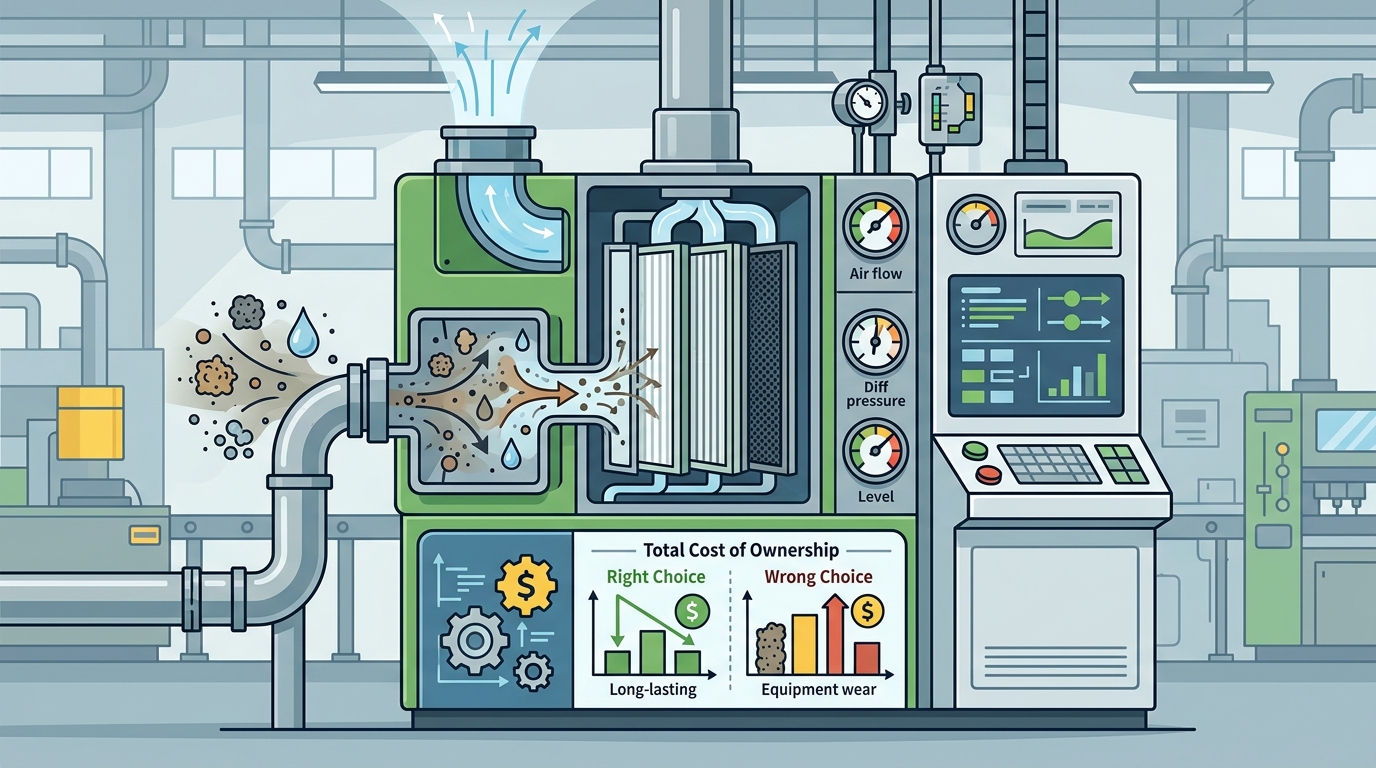
Step 7: Evaluate Total Cost of Ownership
The purchase price of a filtration system represents only a fraction of its lifetime cost. A comprehensive evaluation should consider:
- Filter lifespan and replacement cost: Systems with longer filter life deliver lower ongoing expense. For example, the ARO mist collectors from Aeroex feature mechanical elements lasting up to 20 years, agglomerator filters lasting 10–15 years, and HEPA filters lasting 2–4 years.
- Energy consumption: Filters that clog or restrict airflow force the system to work harder. Evaluate pressure drop data from the manufacturer.
- Maintenance labour: Easy access to filter compartments reduces downtime during replacements.
- Fluid recovery: In metalworking applications, mist collectors that drain captured coolant back to the machine sump reduce fluid purchasing costs.
- Avoided costs: Factor in reduced equipment maintenance, fewer HVAC coil cleanings, lower reject rates, and avoided regulatory penalties.
A filter that lasts longer may offer better value even if the initial cost is higher. Always compare systems on a per-year or per-part-produced basis.
Step 8: Industry-Specific Considerations
Different manufacturing sectors require different filtration strategies. Here is a quick reference:
- CNC machining and metalworking: Oil mist and coolant mist are the primary concerns. Multi-stage mist collectors with HEPA final filtration are the standard solution. Aeroex's solutions are ideal for industries such as machining, metalworking, and manufacturing, particularly where heavy oil, coolant, or smoke filtration is required.
- Welding and fabrication: Welding fume has been classified as a human carcinogen with the lung as the target organ. High-efficiency source extraction with MERV 15+ filtration is essential.
- Woodworking: High-volume dust with combustible properties requires baghouse or cartridge collection with NFPA-compliant explosion protection.
- Pharmaceutical manufacturing: Focus on contamination control with HEPA or ULPA filtration and GMP compliance. Cleanroom-grade systems are essential.
- Food processing: Hygiene and air cleanliness are paramount. Oil mist from cooking sprays, smoke, and odour control all require tailored filtration.
- Electronics manufacturing: Focus on static-sensitive contamination prevention with cleanroom-level particle control.
Key Takeaways
- Always start by identifying your specific contaminants and their particle sizes before evaluating any equipment.
- MERV 11–16 filters are recommended for most industrial settings; HEPA filtration (99.97 percent at 0.3 µm) is required for sub-micron particle control.
- Match your technology to the contaminant: mechanical filters for dust, multi-stage mist collectors for oil and coolant mist, activated carbon for VOCs and odours.
- Combine source capture at high-emission machines with ambient capture for whole-facility air quality.
- Size systems based on facility volume, required air changes per hour, and process airflow specifications.
- Regulatory compliance is not optional—OSHA PELs are enforceable and penalties can exceed $165,000 per wilful violation.
- Evaluate total cost of ownership including filter life, energy, maintenance, and avoided costs rather than purchase price alone.
- Request a trial or on-site evaluation from your filtration provider to validate performance before committing.
Frequently Asked Questions
What MERV rating do I need for an industrial manufacturing facility?
For industrial settings where stricter controls are mandatory, MERV 11 to 16 filters are recommended. The exact rating depends on your contaminant type and particle size. Applications involving fine oil mist or welding fume typically require MERV 14 or higher, often with a HEPA after-filter for sub-micron particle capture.
What is the difference between source capture and ambient capture air filtration?
Source capture systems collect contaminants directly at the machine or process, preventing them from dispersing. Ambient capture systems filter the general plant atmosphere from ceiling-mounted or floor-standing units. Most facilities benefit from combining both approaches for optimal air quality.
How do I know if my facility is compliant with OSHA air quality standards?
Compliance requires measuring actual worker exposures against OSHA Permissible Exposure Limits through baseline and periodic air quality testing. If air quality testing reveals that your facility exceeds OSHA exposure limits, engineering controls such as industrial air filtration must be implemented. Consulting an industrial hygienist is recommended for initial assessments.
How often do industrial air filters need to be replaced?
Replacement frequency varies by technology, contaminant loading, and operating hours. Pre-filters may need monthly replacement, while high-quality depth-loading fibrebed filters can last one to three years. Some mechanical elements, such as those used in Aeroex ARO mist collectors, can last up to 20 years with proper maintenance.
Can one filtration system handle both dust and oil mist?
Dust and oil mist behave differently and typically require different filter media. Oil mist collectors use coalescing fibrebed media, while dust collectors use pleated cartridge or bag filters. Facilities with both contaminant types usually need separate systems optimised for each application.
What should I look for when requesting a quote from a filtration provider?
Ask for pressure drop data, filter efficiency ratings with independent test results, expected filter lifespan under your operating conditions, energy consumption figures, warranty terms, and references from similar applications. A reputable provider should also offer an on-site evaluation and, ideally, a trial period so you can verify performance before purchase.