
How to Select the Best Industrial Air Filtration System for Your Manufacturing Facility
Choosing the right industrial air filtration system is one of the most consequential decisions a plant manager or EHS leader can make. The wrong system wastes energy, fails compliance audits, and leaves workers breathing contaminated air. The right one protects your team, extends machine life, and keeps regulators satisfied. This guide walks you through every factor you need to evaluate, from contaminant type and airflow capacity to capture strategy and long-term maintenance costs, so you can invest with confidence.
Why Industrial Air Filtration Matters Now More Than Ever
Industrial air filtration is the process of removing airborne contaminants such as oil mist, coolant mist, smoke, fumes, and dust from a manufacturing environment. According to Aeroex's full guide for manufacturers, as machining operations become faster and more automated, these airborne hazards are increasingly common.
The stakes are real. OSHA's Respiratory Protection standard (29 CFR 1910.134) was cited over 2,400 times in fiscal year 2024, making it one of the top ten most frequently violated standards. Facilities that ignore mist, fume, and dust exposure face citations, fines, and corrective action orders. Beyond compliance, clean air reduces absenteeism, protects equipment, and signals genuine commitment to worker safety.
Step 1: Identify Your Airborne Contaminants
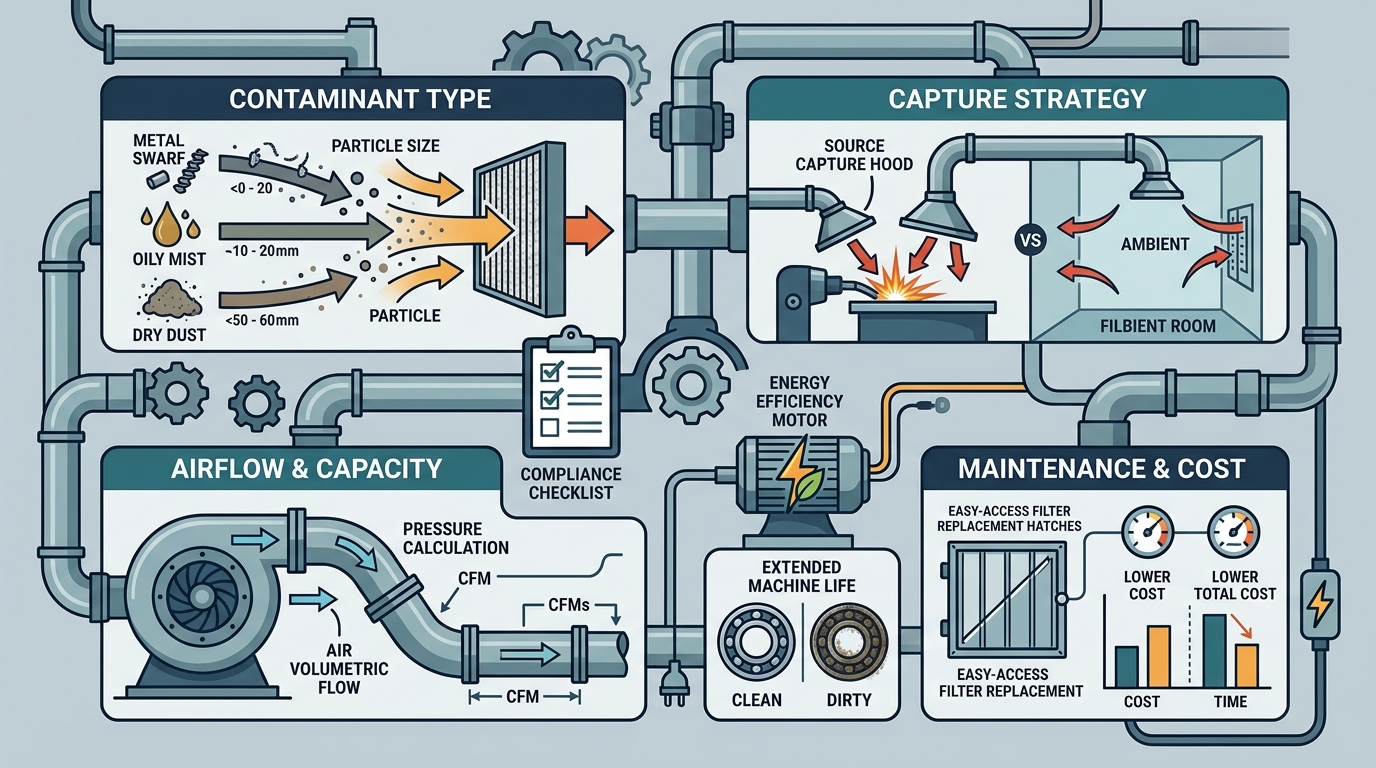
Before selecting hardware, you need to know exactly what is in your air. The most common industrial air pollutants fall into three categories:
Smoke
Smoke is solid particulates released into the air as a byproduct of combustion. Particle size and composition vary with combustion temperature and the material being consumed. Common sources include diesel engines and generators.
Mist
Mist is liquid droplets of a substance or mixture suspended in the air. Oil mist, coolant mist, and water-soluble fluid aerosols are the primary offenders in metalworking shops. Safety impacts vary with the materials in use and their chemistry.
Fumes and VOCs
Fumes are ultra-fine particles created when vaporized metals or chemicals condense. Volatile organic compounds (VOCs) add another layer of risk. Aeroex engineered solutions use carbon-based filters that capture harmful gases, VOCs, and odors by adsorbing molecules at the molecular level.
Step 2: Choose Between Source Capture and Ambient Capture
Capture strategy is the method by which contaminated air is drawn into the filtration system. Your facility layout and pollutant sources dictate which approach works best.
| Factor | Source Capture | Ambient Capture |
|---|---|---|
| Best for | Discrete, identifiable pollutant sources (e.g., CNC machines) | General protection across a large open floor |
| Efficiency | High; captures contaminants at the point of generation | Moderate; passively cleans all circulating air |
| Installation | Mounted on or near each machine | Ceiling-mounted for optimal distribution |
| Example Product | Aeroex Mist-Fit Series | Aeroex Iris-2000 |
Source capture is the most efficient approach when you can pinpoint a polluter source. Ambient capture continuously purifies all plant air and is best suited for facilities where contaminants are dispersed. Many manufacturers combine both strategies for layered protection.
Step 3: Size Your System for Proper Airflow
Airflow capacity, measured in cubic feet per minute (CFM), is the volume of air a filtration unit can process. Undersizing leads to incomplete capture; oversizing wastes energy and capital.
To determine the right CFM, calculate the total air volume of your workspace and aim for a minimum of six to twelve air changes per hour, depending on pollutant concentration. For source-capture units, match the CFM rating to the machine's exhaust port specifications. The Aeroex Maverick line offers airflow capacities from 400 to 4,000 CFM, covering everything from single-machine installations to centralized systems.
Step 4: Match the Right Filtration Technology
Not all filters are created equal. The technology you choose must match the contaminant type, particle size, and concentration level in your facility.
Multi-Stage Mechanical Filtration
Multi-stage filtration is a progressive process that moves air through increasingly fine filter media. The Aeroex ARO Series uses four stages of filter media to target increasingly small contaminants, removing 95% of mist particles in the first stage alone. Mechanical elements can last up to 20 years, and HEPA filters typically last 2 to 4 years.
HEPA Filtration
A HEPA filter is a high-efficiency particulate air filter capable of capturing 99.97% of particles at 0.3 microns. HEPA is recommended by the CDC as the highest standard for air filtration, making it essential for facilities that demand medical-grade air quality.
Carbon Filtration
Activated carbon filters adsorb gases, VOCs, and odors at the molecular level. They are ideal for environments requiring chemical pollutant removal alongside particulate filtration.
Step 5: Ensure OSHA and EPA Compliance
A Permissible Exposure Limit (PEL) is the maximum concentration of an airborne substance to which workers may be exposed over an 8-hour shift, as established by OSHA's annotated PEL tables. For mineral oil mist, the current OSHA PEL is 5 mg/m³ as an 8-hour TWA.
OSHA itself acknowledges that many of its PELs are outdated. Prudent practice dictates using whichever exposure limit is more protective. Installing industrial air filtration systems demonstrates accountability and helps avoid the types of violations frequently cited under 29 CFR 1910.134 and 29 CFR 1910.1000.
Step 6: Evaluate Total Cost of Ownership
Purchase price is only part of the equation. A truly cost-effective system minimizes ongoing filter replacements, energy consumption, and maintenance labor.
| Cost Factor | What to Look For |
|---|---|
| Filter Lifespan | Washable pre-filters and long-life fibrebed media (1 to 3 years for MERV 15 rated filters) |
| Energy Use | Variable frequency drives (VFDs) to match motor speed to demand |
| Maintenance | Modular designs with tool-free filter access |
| Fluid Recovery | Systems that drain captured coolant or oil back to the machine sump |
| Trial Programs | Risk-free trials lasting 30 to 60 days to verify performance before committing |
Aeroex offers a free trial program so you can deploy mist collectors in your environment and assess performance before purchase. This approach eliminates guesswork and confirms ROI with real data from your own floor.
Key Takeaways
- Start by identifying your specific contaminants: smoke, mist, fumes, or VOCs each require different filtration media.
- Choose source capture for targeted, high-efficiency removal at individual machines, or ambient capture for broad facility coverage.
- Size your system by calculating required CFM based on workspace volume and desired air changes per hour.
- Multi-stage filtration with HEPA final stages delivers the highest capture efficiency, reaching 99.97% at 0.3 microns.
- OSHA's PEL for mineral oil mist is 5 mg/m³, but best practice is to aim well below this threshold.
- Evaluate total cost of ownership, not just sticker price, by factoring in filter life, energy use, and fluid recovery.
- Request a trial period to validate system performance in your actual operating conditions before committing.
Frequently Asked Questions
What is an industrial air filtration system?
An industrial air filtration system is equipment designed to pull contaminated air from a manufacturing environment, pass it through progressive filter media, and return clean air to the workspace. These systems address oil mist, coolant mist, smoke, fumes, and other harmful particles.
How do I know which contaminants are in my facility?
Conduct an air quality assessment or hire an industrial hygienist to sample your plant air. Identify whether your processes generate smoke, mist, fumes, or VOCs, as each requires different filtration approaches.
What is the difference between source capture and ambient capture?
Source capture collects contaminated air directly at the point of generation, such as a CNC machine enclosure. Ambient capture draws air from the general environment, typically through ceiling-mounted units, to provide broad facility-wide filtration.
What airflow capacity (CFM) do I need?
Calculate your workspace volume and target six to twelve air changes per hour. For source-capture applications, match the unit's CFM to the machine exhaust specifications. Systems like the Aeroex Maverick range from 400 to 4,000 CFM to suit different scales.
How often do filters need to be replaced?
It depends on the filter type and contaminant load. Aeroex ARO Series mechanical elements last up to 20 years, agglomerator filters last 10 to 15 years, and HEPA filters typically last 2 to 4 years. Washable pre-filters reduce replacement frequency further.
What OSHA standards apply to air quality in manufacturing?
Key standards include the Respiratory Protection standard (29 CFR 1910.134) and the Air Contaminants standard (29 CFR 1910.1000). The PEL for mineral oil mist is 5 mg/m³ as an 8-hour TWA. OSHA recommends using more protective limits from ACGIH or NIOSH where available.
Can I try a system before purchasing?
Yes. Aeroex offers a trial program typically lasting 30 to 60 days, allowing you to deploy mist collectors in your facility and evaluate performance with no obligation.
Does Aeroex offer custom solutions for unique applications?
Aeroex specializes in crafting custom solutions tailored to your space, air quality requirements, and efficiency needs. Their engineered systems serve industries from metalworking and food production to aerospace and soil remediation.
Get a Free Air Quality Consultation
Every facility is different. The fastest way to find the right filtration system is to speak with an engineer who understands your process. Request a free consultation from Aeroex and receive a tailored recommendation based on your contaminant profile, floor layout, and production goals.