
Industrial Air Filtration Systems: Key Factors to Consider Before You Buy
Choosing an industrial air filtration system for your factory is one of the most consequential decisions you will make for worker safety, regulatory compliance, and long-term operating costs. With OSHA consistently ranking respiratory protection among its most cited standards, the pressure to get filtration right has never been higher. This guide walks you through the key factors every facility manager, plant engineer, or procurement specialist should evaluate before committing to a system. Whether you handle oil mist, coolant mist, smoke, or fine particulate, the criteria below will help you invest wisely.
1. Identify Your Contaminant Types
The first step in selecting any filtration system is understanding exactly what you need to remove from the air. Industrial air quality pollutants generally fall into three categories: smoke, mist, and fumes. Smoke is solid particulate released as a byproduct of combustion, while mist consists of liquid droplets suspended in air. Fumes are fine solid particles formed when vaporized metals condense.
Different machining operations produce different contaminant profiles. CNC machining and metalworking commonly generate oil mist and coolant mist, whereas welding and thermal cutting produce metal fumes. Visit Aeroex's full guide to industrial air filtration for a deeper look at contaminant classification and how each type is best addressed.
2. Understand Filtration Technologies
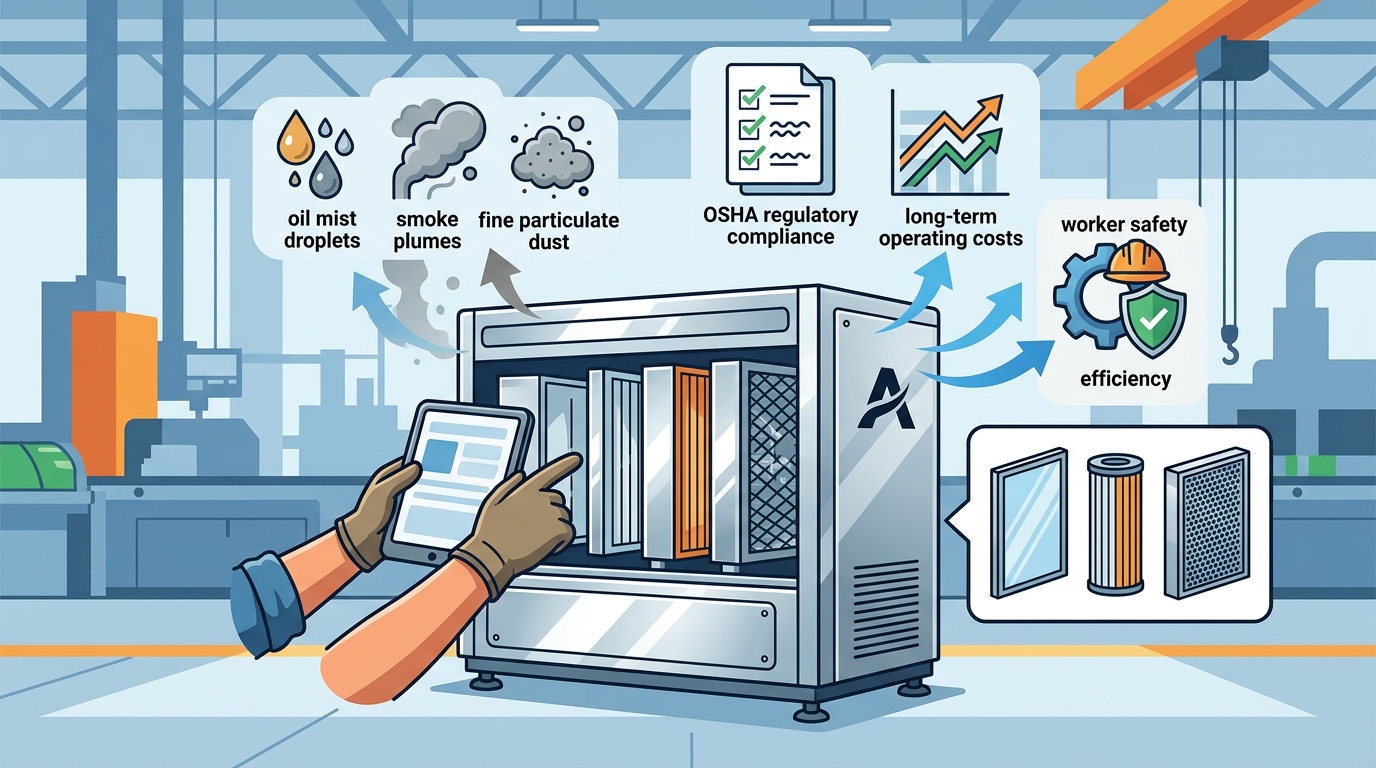
An industrial air filtration system is a mechanical device that pulls contaminated air through progressive filter stages to remove harmful particles before recirculating clean air. Several core technologies are available, and the right choice depends on your contaminant profile.
Multi-Stage Mechanical Filtration
Multi-stage systems use a sequence of increasingly fine filters to separate particles. Aeroex's ARO Series mist collectors, for example, remove 95% of mist particles in the first stage alone, which extends downstream filter life and reduces replacement costs. A final HEPA stage can capture 99.97% of sub-micron particles for the most demanding environments.
Electrostatic Precipitators
An electrostatic precipitator (ESP) is a device that uses an electrical charge to attract and collect airborne particles on metal plates. While ESPs eliminate ongoing filter costs, the plates require regular cleaning, and they may not effectively remove gases or volatile organic compounds.
Carbon Filtration
Carbon filters adsorb harmful gases, VOCs, and odors at the molecular level. They are ideal for applications requiring chemical pollutant removal beyond standard particulate filtration. Aeroex integrates carbon filtration into its engineered solutions for facilities facing complex air quality challenges.
3. Source Capture vs. Ambient Capture
How you position a filtration system matters as much as the technology inside it. A source capture system is installed directly at or near the machine generating contaminants, providing the most efficient removal by catching pollutants before they disperse. An ambient capture system is mounted centrally, often on the ceiling, and continuously purifies all the air in a room.
Source capture is best when you can identify a discrete pollution source. Ambient capture suits facilities with many distributed sources or where general air quality improvement is the goal. Aeroex offers both approaches, including the ceiling-mounted Iris series for ambient applications and the compact Mist-Fit series for direct machine mounting.
4. Regulatory Compliance and OSHA Requirements
Compliance is not optional. According to OSHA's annotated PEL tables, permissible exposure limits exist for approximately 500 substances, and many of these PELs date back to 1970. OSHA itself acknowledges that many limits are outdated and recommends employers consider stricter alternative exposure limits from NIOSH and ACGIH.
In fiscal year 2024, the Respiratory Protection standard (29 CFR 1910.134) was cited over 2,400 times, making it one of the top ten most frequently violated standards. Facilities that fail to control mist, fume, and dust exposure risk citations, fines, and corrective action orders. Installing an effective air filtration system demonstrates accountability to regulators, employees, and customers alike.
5. Maintenance and Total Cost of Ownership
Purchase price is only part of the equation. Total cost of ownership (TCO) includes filter replacements, energy consumption, downtime for servicing, and fluid recovery. Systems with washable pre-filters and long-life primary filters dramatically lower recurring costs.
For context, Aeroex's ARO Series mechanical element can last up to 20 years, the agglomerator filter 10 to 15 years, and HEPA filters typically 2 to 4 years. Compare that with systems requiring quarterly filter swaps, and the savings become substantial over a 10-year equipment lifecycle. Explore Aeroex's filtration technology page for details on filter longevity and drainage design.
6. System Sizing and Airflow Capacity
Airflow capacity, measured in cubic feet per minute (CFM), must match or exceed the volume of contaminated air your machinery generates. Undersized systems fail to capture contaminants effectively, while oversized units waste energy and capital.
Modern product lines cover a wide range. The Aeroex Maverick line, for instance, offers airflow capacities from 400 to 4,000 CFM with flexible mounting options and intelligent monitoring. Matching system capacity to your specific machine configuration and process demands is best handled through a professional site assessment.
7. Filtration Technology Comparison
| Factor | Multi-Stage Mechanical | Electrostatic Precipitator | Carbon Filtration |
|---|---|---|---|
| Best For | Oil mist, coolant mist, smoke | Dry particulate, light oil mist | VOCs, gases, odors |
| Particle Capture | Up to 99.97% (with HEPA) | 95-98% typical | Molecular-level adsorption |
| Filter Replacement | 1-20 years depending on stage | None (plate cleaning required) | 6-24 months typical |
| Maintenance Level | Low to moderate | Moderate (electrical cleaning) | Moderate (media replacement) |
| Gas/VOC Removal | No (unless combined with carbon) | No | Yes |
| Upfront Cost | Moderate | High | Low to moderate |
Key Takeaways
- Identify your specific contaminants (oil mist, coolant mist, smoke, fumes, VOCs) before evaluating any system.
- Multi-stage mechanical filtration with HEPA capability delivers up to 99.97% sub-micron particle removal.
- Choose source capture for targeted, high-efficiency collection and ambient capture for facility-wide air quality.
- OSHA compliance is mandatory; respiratory protection was cited over 2,400 times in fiscal year 2024.
- Total cost of ownership matters more than purchase price; look for filter lifespans measured in years, not months.
- Match system CFM to your actual airflow requirements through a professional assessment.
- Work with a manufacturer that offers trial periods and custom engineering to fit your unique facility needs.
Frequently Asked Questions
What is an industrial air filtration system?
An industrial air filtration system is equipment designed to remove airborne contaminants such as oil mist, coolant mist, smoke, fumes, and dust from factory and workshop environments. It works by pulling contaminated air through progressive filter stages and returning clean air to the workspace.
How do I know which filtration technology is right for my facility?
Start by identifying your primary contaminants. Oil mist and coolant mist are best handled by multi-stage mechanical filtration with fibrebed and HEPA filters. VOCs and chemical odors require carbon filtration. A professional consultation helps match the right technology to your process.
What OSHA standards apply to air quality in manufacturing?
OSHA enforces permissible exposure limits under the Air Contaminants standard (29 CFR 1910.1000) and the Respiratory Protection standard (29 CFR 1910.134). Employers are also subject to the General Duty Clause, which requires workplaces to be free from recognized hazards.
What is the difference between source capture and ambient capture?
Source capture systems mount directly on or near the contaminant source for maximum efficiency. Ambient capture systems are centrally positioned to clean all the air in a room. Source capture is more efficient for discrete polluters, while ambient capture provides broad protection.
How long do industrial air filters last?
Filter life varies by type. For example, the Aeroex ARO Series mechanical element lasts up to 20 years, agglomerator filters last 10 to 15 years, and HEPA filters typically last 2 to 4 years. Washable pre-filters in some systems further extend overall filter life.
Can I try an industrial air filtration system before committing?
Some manufacturers offer trial programs. Aeroex provides a 30 to 60 day trial period so facilities can evaluate performance before making a final purchase decision.
What is total cost of ownership for an air filtration system?
Total cost of ownership (TCO) includes the initial purchase price plus ongoing costs for filter replacements, energy consumption, maintenance labor, and downtime. Systems with longer filter lifespans and lower energy draw significantly reduce TCO over time.
How do I size an air filtration system for my factory?
Sizing depends on the CFM output of your machinery, the volume of your workspace, and the type and concentration of contaminants. A professional site assessment ensures accurate sizing. Systems range from compact 400 CFM units to large 4,000+ CFM central systems.
Get Expert Guidance for Your Facility
Every factory has unique air quality challenges. Whether you need a single mist collector for a CNC lathe or a full engineered solution for an entire production floor, the right system starts with a proper consultation. Contact the Aeroex engineering team to schedule a site assessment, discuss your contaminant profile, and explore trial options with no obligation.