
How to Choose the Right Industrial Air Filtration System for Your Manufacturing Facility
Selecting the right industrial air filtration system is one of the most consequential decisions a manufacturing facility manager can make. Poor air quality threatens worker health, triggers regulatory penalties, and shortens the life of expensive CNC equipment. With OSHA's Respiratory Protection standard ranking among the top ten most frequently violated standards, the pressure to get filtration right has never been higher. This guide walks you through every factor you need to evaluate, from contaminant type and capture strategy to product sizing and long-term maintenance, so you can invest with confidence.
1. Identify Your Airborne Contaminants
The first step in choosing any filtration system is understanding exactly what you need to remove from the air. Industrial air contaminants generally fall into three categories: smoke, mist, and fumes. Smoke is solid particulate matter released as a byproduct of combustion processes. Mist is liquid droplets of a substance or mixture suspended in the air. Fumes are fine solid particles formed when vaporized metals or chemicals condense.
Common culprits in metalworking shops include oil mist, coolant mist, and welding fumes. In specialty applications like food production, woodworking, and grinding, contaminants range from cooking-spray aerosols to fine wood dust. Identifying your specific pollutant profile determines the filter media, number of filtration stages, and capture method your facility requires.
2. Source Capture vs. Ambient Capture
Once you know what you are filtering, you need to decide where to capture it. There are two primary strategies:
Source Capture
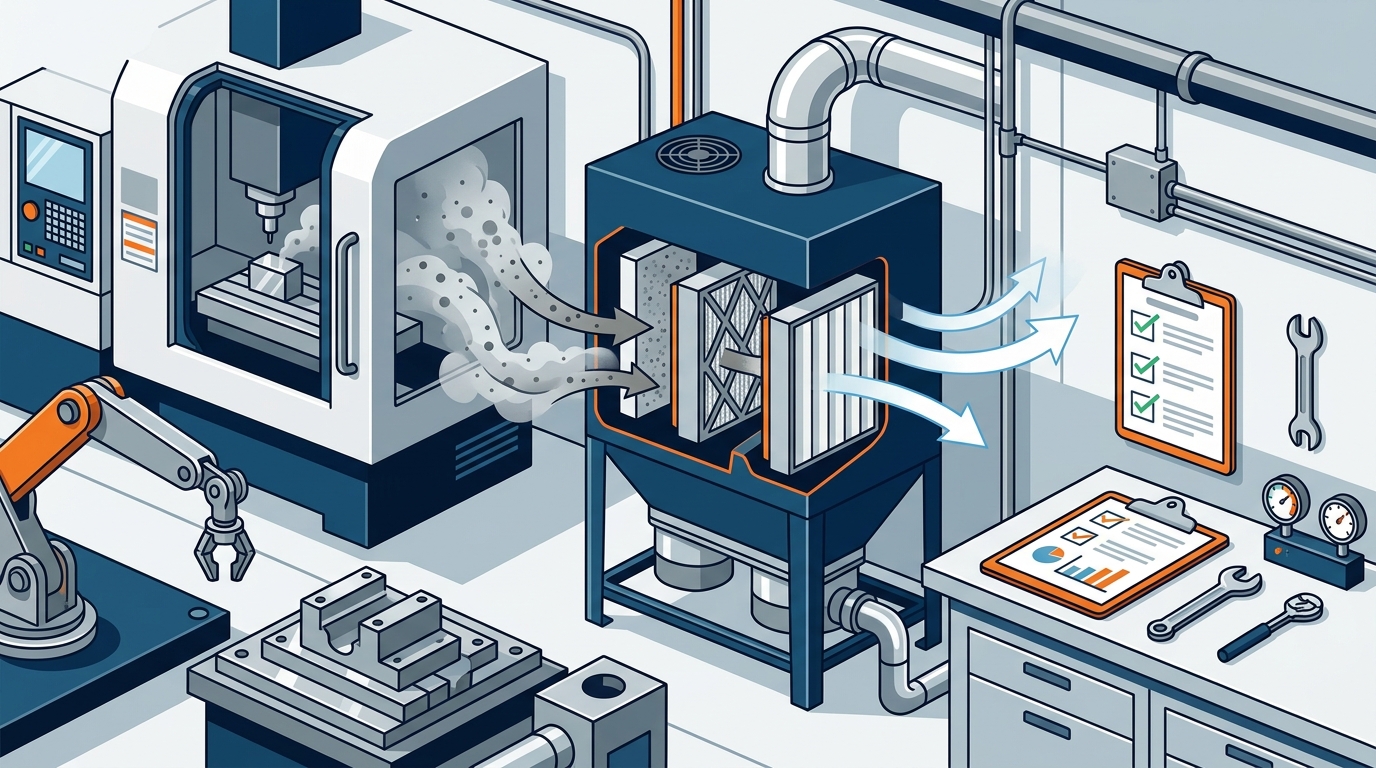
Source capture systems mount directly on or near the polluting machine. They intercept contaminants before they disperse into the wider shop floor. This approach is the most efficient when you can pinpoint a discrete polluter, such as a single CNC lathe generating heavy oil mist. Products like the Mist-Fit series are purpose-built for direct-mount, source-capture applications with a compact footprint.
Ambient Capture
Ambient capture systems treat the entire air volume of a room. Ceiling-mounted units like the Iris-2000 ambient capture system continuously cycle plant air through HEPA and activated carbon filters. This strategy works best when multiple small sources contribute to overall air degradation and no single machine dominates emissions.
| Factor | Source Capture | Ambient Capture |
|---|---|---|
| Best for | Discrete, high-output polluters | Distributed, low-level contamination |
| Installation | Machine-mounted or ducted | Ceiling-mounted or wall-mounted |
| Efficiency | Highest at the point of generation | Broad, facility-wide coverage |
| Typical product | Mist-Fit, ARO Series | Iris-2000 |
| Maintenance | Per-machine filter changes | Centralized filter management |
3. Understand Filtration Technologies
Not all filters work the same way. Choosing the right technology depends on particle size, chemical composition, and required efficiency.
Multi-Stage Mechanical Filtration
Multi-stage filtration is the process of passing contaminated air through progressively finer filter media to remove particles of decreasing size. Aeroex's ARO Series mist collectors use a four-stage process that removes up to 95% of mist particles in the first stage alone, extending downstream filter life significantly.
HEPA Filtration
HEPA (High-Efficiency Particulate Air) filtration is a standard that requires filters to capture at least 99.97% of particles 0.3 microns or larger. Aeroex systems offer optional HEPA stages for facilities that demand the highest air purity, including cleanroom and pharmaceutical environments.
Carbon Filtration
Carbon filtration uses activated carbon media to adsorb gases, volatile organic compounds (VOCs), and odors at the molecular level. Aeroex integrates carbon filters into custom engineered solutions for environments with chemical pollutant challenges.
4. Size the System for Your Airflow Needs
An undersized system will leave contaminants in the air; an oversized system wastes energy and capital. The key metric is CFM (cubic feet per minute), which measures the volume of air a system can process. You should match CFM capacity to the air volume your machines generate or the total room volume you need to cycle.
For example, the Aeroex Maverick mist collector line offers airflow capacities from 400 to 4,000 CFM, covering everything from a single compact machining center to a large central collection system. Consulting with an engineer who can assess your machine configuration and ductwork layout is essential to getting the sizing right.
5. Meet OSHA and EPA Compliance Requirements
Regulatory compliance is not optional. According to OSHA's Air Contaminants standard (29 CFR 1910.1000), employers must control recognized hazards that may result in serious harm. Facilities that fail to address mist, fume, and dust exposure risk citations, fines, and corrective action orders.
A 2024 NIOSH analysis using U.S. National Health Interview Survey data estimated that approximately 896,000 U.S. workers had work-related asthma caused or worsened by their job. In machining environments where oil mist and coolant aerosols are prevalent, these numbers reinforce the need for proper source-capture filtration. Installing a well-designed system demonstrates accountability to employees, regulators, and customers alike.
6. Evaluate Maintenance and Total Cost of Ownership
The purchase price of a filtration unit is only part of the equation. Total cost of ownership (TCO) includes filter replacements, energy consumption, labor for maintenance, and downtime during servicing. Look for systems designed to minimize these ongoing costs.
Aeroex ARO filters, for instance, feature a mechanical element lasting up to 20 years, an agglomerator filter lasting 10 to 15 years, and HEPA filters with a typical 2 to 4 year lifespan. The Mist-Fit line uses washable filters to further reduce recurring expenses. Before selecting a system, request a TCO estimate from your provider that includes a realistic maintenance schedule.
Key Takeaways
- Start by profiling your specific airborne contaminants: smoke, mist, or fumes.
- Choose source capture for discrete, heavy polluters and ambient capture for facility-wide air quality.
- Match filtration technology (mechanical, HEPA, or carbon) to your contaminant type and particle size.
- Size your system using CFM calculations based on machine output and room volume.
- Ensure compliance with OSHA and EPA standards to avoid costly citations.
- Evaluate total cost of ownership, not just purchase price, including filter lifespan and maintenance labor.
- Consult an experienced filtration engineer for a site-specific recommendation.
Frequently Asked Questions
What is an industrial air filtration system?
An industrial air filtration system is a mechanical setup that pulls contaminated air from a facility, passes it through filter media to remove harmful particles, and returns clean air to the workspace. These systems address pollutants like oil mist, coolant mist, smoke, and fumes common in manufacturing.
How do I know if I need source capture or ambient capture?
If you can pinpoint a specific machine generating most of the contamination, source capture is typically more efficient. If pollutants come from many small sources across a large floor area, an ambient capture system provides broader coverage.
What does CFM mean and why does it matter?
CFM stands for cubic feet per minute and measures the volume of air a filtration system can process. Choosing the correct CFM rating ensures your system can handle the contaminant load without being undersized or wastefully oversized.
How often do industrial air filters need to be replaced?
It depends on the filter type and operating conditions. Some mechanical elements can last up to 20 years, while HEPA filters typically last 2 to 4 years. Washable pre-filters can be cleaned and reused, reducing replacement frequency.
Can Aeroex create a custom filtration solution for my facility?
Yes. Aeroex specializes in crafting custom solutions tailored to your space, air quality requirements, and efficiency needs. Their engineering team reviews your application and recommends an appropriate system through a consultation process.
What industries benefit most from industrial air filtration?
Metalworking, machining, automotive manufacturing, aerospace, food production, woodworking, pharmaceuticals, and any facility that generates airborne mist, smoke, dust, or fumes can benefit significantly from proper filtration.
Are industrial air filtration systems required by law?
While there is no single law mandating a specific filtration product, OSHA requires employers to control recognized airborne hazards. Failing to install adequate filtration in environments with known contaminants can result in violations and penalties.
How long does installation typically take?
Installation timelines vary by system complexity. Compact direct-mount units like the Mist-Fit can be installed in as little as one hour. Larger central or ambient systems may require additional planning and ductwork.
Get Expert Help Choosing Your Filtration System
Every facility is different, and the best filtration solution depends on your unique combination of contaminants, machine layout, and compliance requirements. Aeroex offers a free consultation where their engineering team assesses your needs and recommends the right system. Request your consultation today and take the first step toward cleaner, safer air in your manufacturing facility.