
Common Challenges When Implementing Industrial Air Filtration Systems in Factories
Installing an industrial air filtration system should be straightforward, but factory managers frequently encounter obstacles that delay projects, inflate costs, and compromise worker safety. From selecting the wrong equipment to neglecting ongoing maintenance, these pitfalls can turn a critical investment into an underperforming expense. Industrial air filtration is the process of removing airborne contaminants such as oil mist, coolant mist, fumes, and dust from manufacturing environments. In this article, we break down the most common challenges factories face when implementing these systems and provide actionable strategies to address each one.
1. Failing to Identify Contaminant Types
One of the most frequent mistakes is purchasing a filtration system without first understanding what is in the air. Industrial facilities generate a wide range of airborne pollutants during normal operations, and each contaminant requires a different filtration approach. Smoke is solid particulates released as a byproduct of combustion, while mist consists of liquid droplets suspended in the air.
A machining shop dealing with oil mist needs a different solution than a facility managing welding fumes or wood dust. Working with a filtration partner who performs an on-site assessment and engineers a custom solution ensures you match equipment to the actual contaminant profile rather than guessing.
2. Incorrect System Sizing and Airflow Design
An undersized system cannot keep up with contaminant output, while an oversized unit wastes energy and capital. Airflow capacity is a critical specification. For example, systems in the Aeroex Maverick line offer capacities from 400 to 4,000 CFM, providing flexibility for different facility sizes.
How to Size Correctly
Start by measuring the air volume of your workspace and the contaminant generation rate of each machine. Factor in variables like coolant pressure, machine enclosure design, and ambient temperature. An engineering consultation can prevent costly resizing later.
3. Choosing Between Source Capture and Ambient Capture
Source capture is the strategy of collecting contaminated air directly at the point of generation, such as mounting a mist collector on a CNC machine. Ambient capture is the approach of filtering the general air throughout an entire facility. Each method suits different scenarios.
| Factor | Source Capture | Ambient Capture |
|---|---|---|
| Best for | Discrete polluters (CNC, grinders) | Dispersed contaminants, large open areas |
| Efficiency | High; captures at the source | Moderate; cleans general air volume |
| Space needed | Mounts on or near machine | Ceiling-mounted units, minimal floor space |
| Energy use | Lower per unit, targeted | Higher due to larger air volume |
| Example product | ARO Mist Collectors | Iris-2000 Ambient System |
Many facilities benefit from a hybrid approach. The key is understanding whether you can pinpoint the polluter source or need facility-wide protection, then matching the right industrial air purification system accordingly.
4. Underestimating Maintenance Requirements
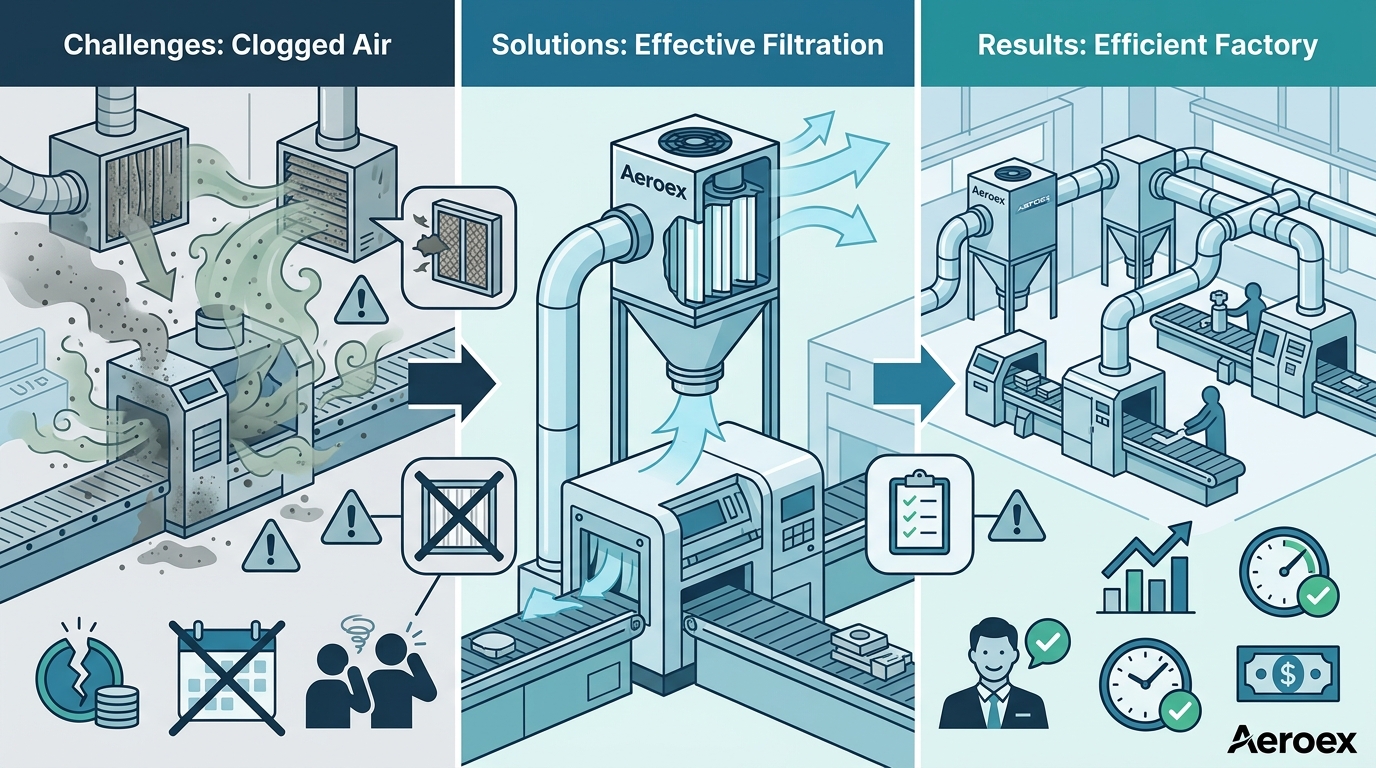
Simply installing a mist collector is not enough to ensure optimal performance. Over time, collectors can become clogged with oil mist, coolant mist, and other particulate matter, reducing efficiency and increasing strain on components. Regular maintenance procedures typically involve cleaning and filter replacement.
Extending Filter Life
Systems designed with multi-stage progressive filtration dramatically reduce maintenance burden. The ARO Series, for example, uses a first-stage mechanical element that separates up to 90% of oil mist before air reaches consumable filters. This design extends filter life to 1 to 3 years for fiber bed stages and up to 20 years for the mechanical element. Establishing a proper maintenance schedule tailored to your usage prevents premature failure and keeps operational costs low.
5. Navigating Regulatory Compliance
Factories that fail to address mist, fume, and dust exposure risk citations, fines, and corrective action orders. According to OSHA data for fiscal year 2024, the Respiratory Protection standard (29 CFR 1910.134) was cited over 2,400 times, making it one of the top ten most frequently violated standards. Air Contaminants (29 CFR 1910.1000) showed similar violation counts.
Compliance is not a one-time checkbox. Facilities must continuously monitor air quality and maintain systems to meet OSHA, EPA, and NIOSH guidelines. Installing filtration that captures particles as small as 0.3 microns helps demonstrate accountability to regulators and employees alike.
6. Space Constraints and Equipment Integration
Factory floors are rarely designed with air filtration in mind. Tight machine spacing, low ceilings, and crowded layouts make installation difficult. Compact, direct-mount collectors solve this problem. The Mist-Fit series features a compact footprint ideal for tight machine spaces without sacrificing airflow performance, with a modular design that allows quick setup.
Ceiling-Mounted Options
When floor space is unavailable, ceiling-mounted ambient systems like the Iris-2000 optimize air circulation from above, ensuring consistent filtration without occupying valuable production area.
7. Managing Total Cost of Ownership
Upfront purchase price is only part of the equation. Total cost of ownership (TCO) is the combined expense of acquisition, installation, energy, filters, maintenance, and downtime over a system's lifetime. Choosing based on price alone often leads to higher long-term costs from frequent filter changes, energy waste, and unplanned repairs.
Key Cost Drivers
Look for systems with long filter lifespans, low energy consumption, and designs that reclaim coolant or oil for reuse. Multi-stage filtration architectures that remove the bulk of contaminants in early, non-consumable stages deliver measurably lower TCO. Aeroex offers a comprehensive filter guide to help you compare lifecycle costs before purchasing.
Key Takeaways
- Always identify your specific contaminant types before selecting a filtration system.
- Size your system based on actual airflow needs, machine count, and coolant pressure.
- Source capture is most efficient for discrete polluters; ambient capture suits dispersed contaminants.
- Multi-stage filtration designs extend filter life and reduce maintenance frequency.
- OSHA respiratory protection and air contaminant standards remain among the most cited violations in manufacturing.
- Compact, direct-mount systems solve space constraint challenges on crowded factory floors.
- Evaluate total cost of ownership rather than upfront price to make a sound investment.
Frequently Asked Questions
What is the biggest challenge when implementing industrial air filtration?
The most common challenge is misidentifying the contaminant profile. Different pollutants like oil mist, smoke, fumes, and dust require distinct filtration technologies. An on-site assessment is the best first step.
How do I choose between source capture and ambient capture?
If you can identify a specific polluter such as a CNC machine or grinder, source capture is more efficient. If contaminants are spread across a large open area, ambient capture provides better general protection. Many factories use both.
How often do industrial air filtration filters need replacing?
Replacement timing depends on mist load, operating hours, and filter design rather than a fixed calendar. In multi-stage systems like the ARO Series, mechanical elements can last up to 20 years, while fiber bed filters typically last 1 to 3 years.
What OSHA regulations apply to factory air quality?
Key standards include the Respiratory Protection standard (29 CFR 1910.134) and Air Contaminants standard (29 CFR 1910.1000). Both were among the most cited OSHA violations in fiscal year 2024.
Can air filtration systems be installed in factories with limited floor space?
Yes. Direct-mount mist collectors attach to individual machines, and ceiling-mounted ambient systems eliminate the need for floor space entirely. Modular designs further simplify installation in tight layouts.
What is total cost of ownership for an air filtration system?
Total cost of ownership includes the purchase price, installation, energy consumption, filter replacements, maintenance labor, and any production downtime. Systems with longer filter lifespans and lower energy draw offer the best TCO.
How does multi-stage filtration reduce maintenance costs?
Multi-stage systems remove the majority of contaminants in early, often non-consumable stages. This protects downstream filters from premature loading, extends their service life, and reduces the frequency of replacements.
Does Aeroex offer trial periods for their filtration systems?
Yes. Aeroex provides a 30 to 60 day trial period so facilities can assess machine performance and efficiency before committing to a purchase.
Get a Free Air Quality Assessment
Stop guessing about your factory's air quality challenges. Request a free consultation with Aeroex to get an expert assessment of your facility, a tailored system recommendation, and access to a risk-free trial of industry-leading mist collectors and air purification systems.