
How to Maintain Industrial Air Filtration Systems for Peak Efficiency
Industrial air filtration systems are the backbone of safe, productive manufacturing environments. Without consistent upkeep, filters clog, airflow drops, and contaminant levels rise, putting worker health and regulatory compliance at risk. Whether you run CNC machining centers, metalworking lines, or general manufacturing operations, a proactive maintenance program keeps your systems running efficiently and extends equipment life. This guide walks you through every essential step, from routine inspections to filter replacement schedules, so your factory air stays clean and your operations stay profitable.
Why Filtration Maintenance Matters
A poorly maintained filtration system does more than waste energy. It recirculates harmful oil mist, coolant aerosols, and fine particulates back into the workspace. Over time, this degrades air quality, increases employee sick days, and accelerates wear on expensive CNC equipment.
According to a documented case study from a Midwest machining plant, source-capture mist collectors eliminated more than 80% of airborne oil mist and delivered full ROI in under two years through maintenance savings and reduced absenteeism. The takeaway is clear: maintenance is not a cost center but an investment in uptime and safety.
Step 1: Establish a Regular Inspection Schedule
Regular inspection and cleaning schedules are paramount to prevent the buildup of contaminants and maintain efficient operation. A preventive maintenance (PM) schedule is a documented plan that defines when each component of your filtration system gets checked, cleaned, or replaced.
What to Inspect
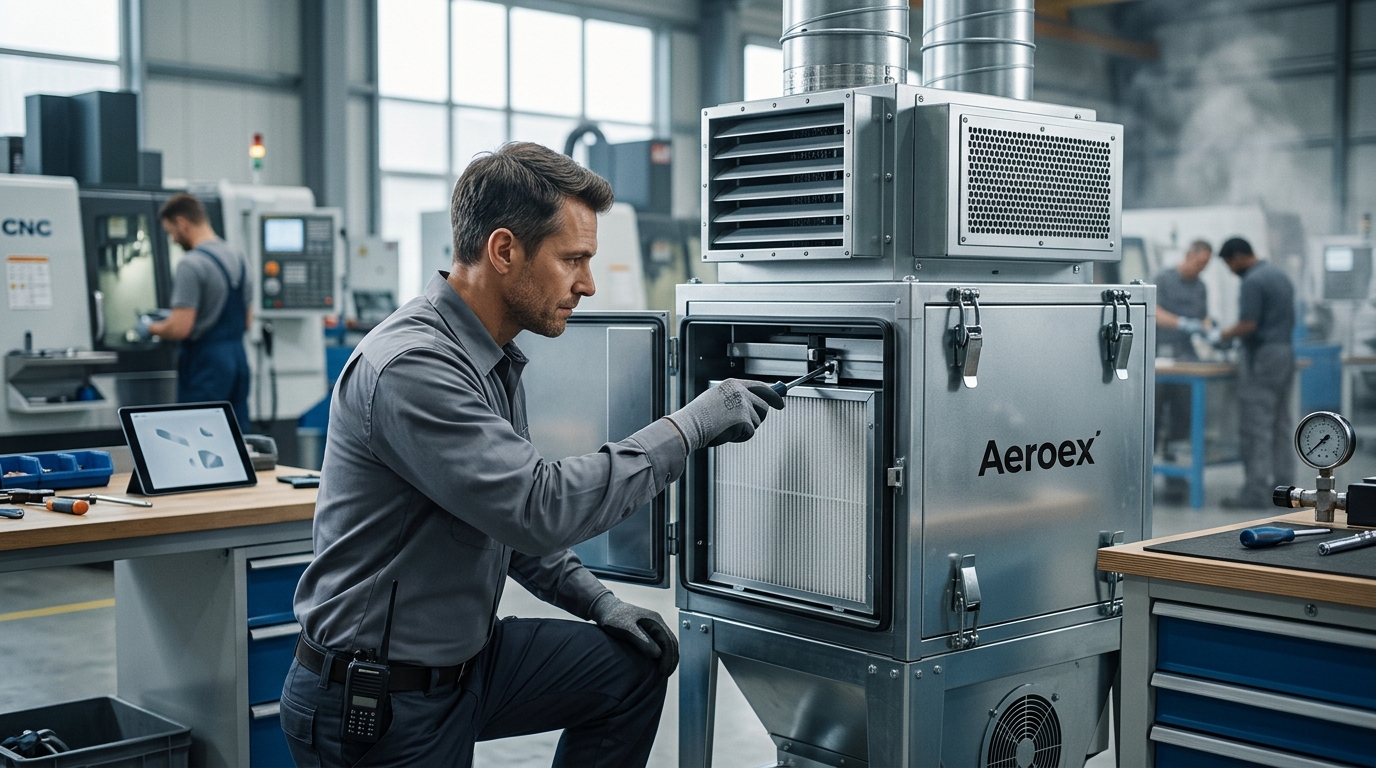
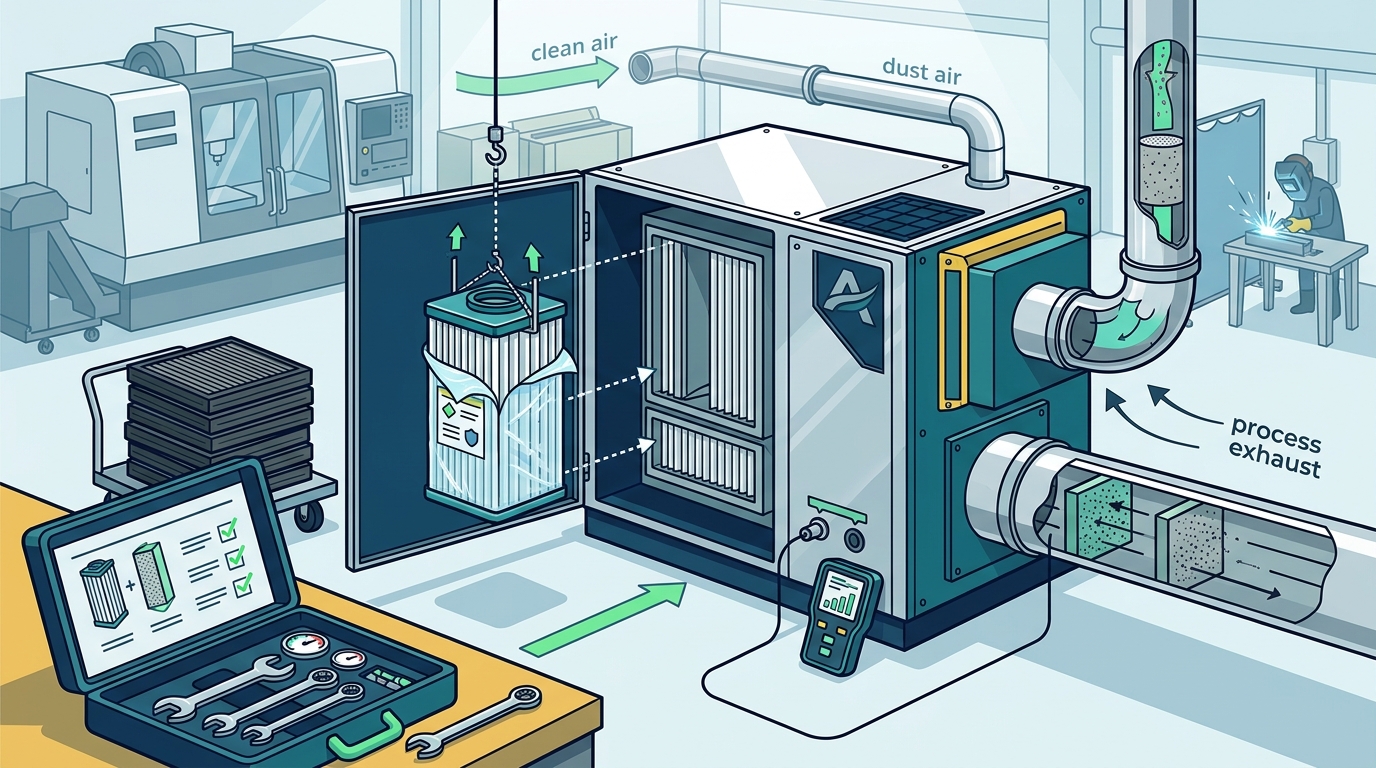
Focus on access points, housing seals, drain lines, and fan motors. Look for visible oil buildup, unusual vibration, or changes in airflow noise. Aeroex mist collectors feature user-friendly designs with accessible access points and easy-access filters that streamline routine inspections.
Recommended Frequency
| Component | Inspection Interval | Action |
|---|---|---|
| Housing & seals | Weekly | Visual check for leaks or buildup |
| Drain lines | Weekly | Confirm fluid is returning to sump |
| Pre-filters / mechanical elements | Monthly | Clean or wash as needed |
| Depth-loading fiber bed filters | Quarterly | Check differential pressure |
| HEPA filters | Semi-annually | Measure pressure drop; replace if needed |
| Fan motor & bearings | Quarterly | Listen for noise; check amperage |
Step 2: Replace Filters at Recommended Intervals
A filter replacement schedule is a manufacturer-defined timeline dictating when each filter stage should be swapped to maintain rated efficiency. Proper filter replacement at recommended intervals is crucial to sustain filtration efficiency.
With Aeroex ARO series mist collectors, the mechanical element can last up to 20 years, agglomerator filters 10 to 15 years, and HEPA filters typically 2 to 4 years. Depth-loading fiber bed filters rated MERV 13 and MERV 14 offer 1 to 3 year lifespans thanks to 25 times more surface area than standard filters.
Signs a Filter Needs Replacing
- Differential pressure exceeds manufacturer specs
- Visible mist escaping the exhaust
- Noticeable drop in airflow volume
- Increased odor in the workspace
Step 3: Monitor Filter Performance Continuously
Performance monitoring is the practice of tracking measurable indicators like differential pressure, airflow velocity, and particulate counts to detect efficiency losses early. Monitoring filter performance allows for early detection of any issues or reductions in effectiveness, prompting timely intervention.
Install differential pressure gauges across each filter stage. Many facilities also use particle counters to verify output air quality. If you are running high-pressure coolant operations, review how high-pressure coolant mist affects collector performance to set appropriate baselines.
Step 4: Leverage Multi-Stage Filtration Technology
Not all filtration systems are built equally. Multi-stage depth-loading filtration technology is a progressive approach that captures the largest particles first, protecting downstream filters and extending overall system life.
The ARO-2000, for example, uses five stages. The first mechanical element separates up to 90% of oil mist and swarf, while a demister stage removes up to 95% of remaining mist with washable, non-consumable filters. This progressive design means fewer filter replacements and lower lifecycle costs compared to single-stage centrifugal systems that clog quickly.
Why Progressive Filtration Reduces Maintenance
When 90 to 95% of contaminants are removed before reaching fine fiber bed or HEPA stages, those expensive filters last significantly longer. This is what separates a well-engineered system from one that demands constant attention.
Step 5: Stay Aligned with OSHA and EPA Standards
Regulatory compliance is not optional. OSHA standard 29 CFR 1910.134 requires employers to use engineering controls like ventilation and filtration as the primary defense against airborne contaminants. Permissible Exposure Limits (PELs) under 29 CFR 1910.1000 set maximum allowable concentrations for specific substances during an 8-hour workday.
Keeping your filtration systems maintained ensures you stay below PEL thresholds and avoid costly fines. For a deeper look at how mist collectors support environmental compliance, read the role of mist collectors in regulatory compliance.
Understanding Total Cost of Ownership
Initial costs include system purchase, installation, and ductwork. Long-term costs involve filter replacement, energy use, and maintenance. While advanced systems carry higher upfront costs, they often reduce long-term expenses through extended filter life, lower energy draw, and fewer unplanned shutdowns.
Cleaner air also leads to fewer sick days and lower workers' compensation claims. Improved airflow and reduced contaminant buildup increase machine uptime and throughput. To explore cost savings from using a CNC mist collector, Aeroex provides detailed breakdowns of return on investment.
Key Takeaways
- Establish a documented inspection schedule with weekly, monthly, and quarterly checkpoints.
- Replace filters at manufacturer-recommended intervals; do not wait for visible failure.
- Use differential pressure gauges and particle counters to monitor performance continuously.
- Multi-stage filtration systems dramatically reduce maintenance frequency by capturing 90 to 95% of contaminants in the first stages.
- HEPA filters in well-designed systems like the ARO series can last 2 to 4 years, with mechanical elements lasting up to 20 years.
- Regulatory compliance under OSHA PELs requires functioning engineering controls, making filtration maintenance a legal obligation.
- Total cost of ownership drops when you invest in quality filtration that minimizes consumable replacements and downtime.
Frequently Asked Questions
How often should I inspect my industrial air filtration system?
Perform visual housing and drain checks weekly, clean pre-filters monthly, and check depth-loading and HEPA filters quarterly to semi-annually. Refer to the maintenance schedule provided in your product documentation for model-specific guidance.
What is multi-stage filtration and why does it matter?
Multi-stage filtration is a progressive process that uses multiple filter layers of increasing efficiency to remove contaminants from the air. It matters because capturing 90 to 95% of particles early protects expensive downstream filters, extending their lifespan and reducing replacement costs.
How long do HEPA filters last in industrial mist collectors?
In well-designed systems like the Aeroex ARO series, certified HEPA filters typically last 2 to 4 years. The mechanical elements can last up to 20 years due to their durable, non-consumable design.
Does OSHA require air filtration in factories?
OSHA requires employers to use engineering controls, including ventilation and filtration, to prevent atmospheric contamination in the workplace. Permissible Exposure Limits under 29 CFR 1910.1000 set enforceable ceilings for airborne contaminants during an 8-hour shift.
What are the signs that a filter needs replacing?
Key indicators include elevated differential pressure readings, visible mist or particles escaping the exhaust, reduced airflow, and increased workplace odors. Proactive monitoring catches these issues before they impact air quality or production.
Can I wash and reuse industrial air filters?
Some filter stages are washable. For example, the demister elements in the ARO-2000 are non-consumable and can be washed. However, depth-loading fiber bed and HEPA filters are not reusable and must be replaced when they reach the end of their service life.
How does poor filtration maintenance affect production costs?
Neglected filters increase energy consumption, cause unplanned downtime, accelerate machine wear, and raise the risk of OSHA violations. Proactive maintenance has been shown to deliver full ROI in under two years through reduced absenteeism and lower equipment repair costs.
What filtration system is best for high-mist CNC environments?
Systems with progressive multi-stage filtration, such as the Aeroex ARO series, are purpose-built for high-mist applications. They handle temperatures up to 70 degrees Celsius and pH levels from 5.8 to 12, making them suitable for demanding metalworking environments.
Keep Your Factory Air Clean: Talk to an Expert
Maintaining your air filtration system does not need to be complicated. Aeroex engineers can assess your facility's specific needs and recommend a maintenance plan or system upgrade tailored to your operation. Request a free consultation and experience the difference that properly maintained, purpose-built filtration makes.