
How to Maintain Industrial Air Filtration Systems for Peak Efficiency
Industrial air filtration systems are the backbone of safe, productive manufacturing environments. Without a consistent maintenance routine, filters clog, airflow drops, and contaminant levels rise, putting worker health and regulatory compliance at risk. Whether you operate CNC machining centers, grinding stations, or a full metalworking shop, keeping your filtration equipment in top shape directly impacts air quality, equipment longevity, and your bottom line. This guide walks you through every essential maintenance step so your systems deliver clean air year after year.
Why Filtration Maintenance Matters
A neglected air filtration system does not just underperform; it becomes a liability. Reduced filtration efficiency allows oil mist, coolant mist, smoke, and fumes to accumulate in the breathing zone of your workers. Over time, this leads to increased sick days, higher workers' compensation claims, and potential OSHA citations.
Proper maintenance also protects your machinery. Contaminant buildup on precision equipment accelerates wear and reduces throughput. One documented case study from a Midwest machining plant showed that source-capture mist collectors eliminated over 80% of airborne oil mist, with the investment recovered in under two years through maintenance savings and reduced absenteeism.
Establish Regular Inspection Schedules
A preventive maintenance schedule is the single most important habit you can adopt. Inspection frequency is the practice of checking filtration components on a fixed calendar to catch issues before they cause downtime.
What to Inspect and When
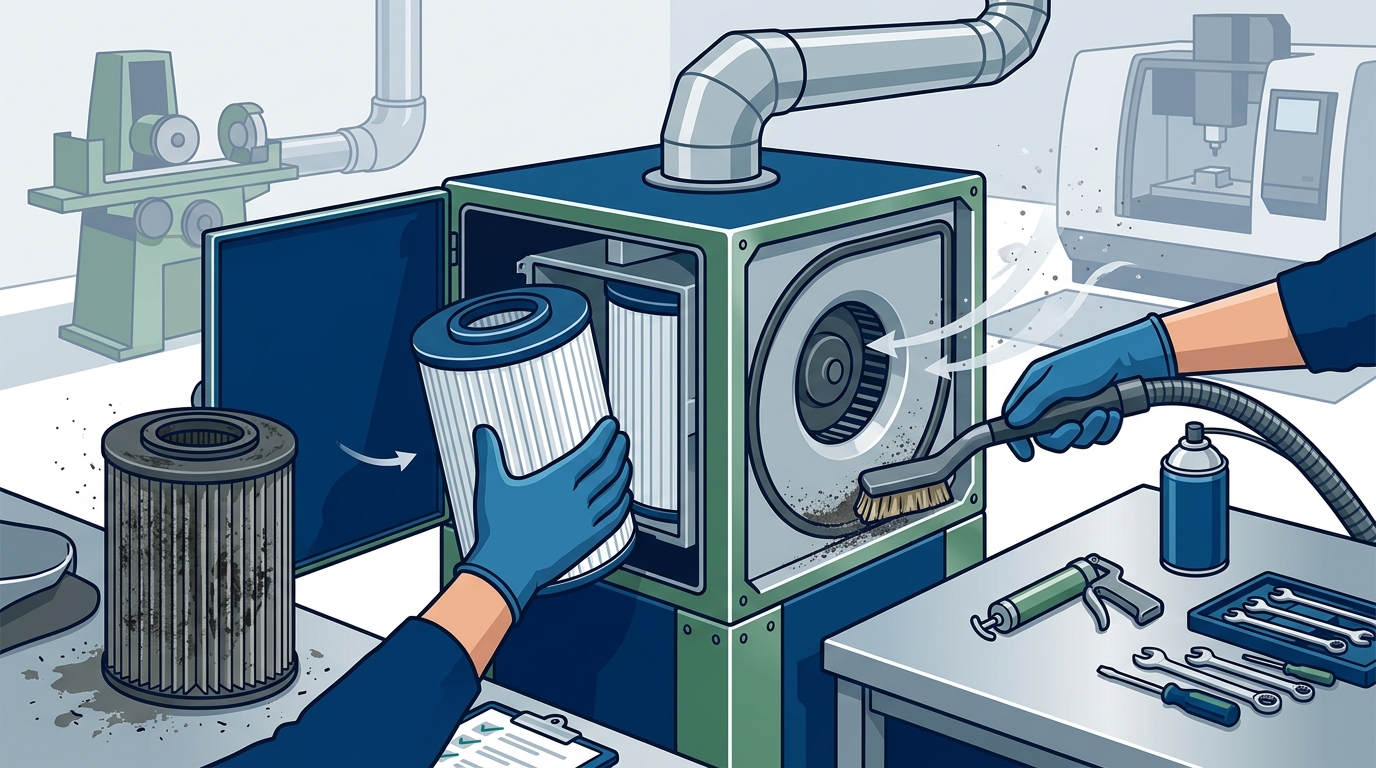
Perform visual inspections of housing seals, ductwork connections, and drainage paths weekly. Quarterly, check fan motors, belts, and electrical connections. Semi-annually, conduct a thorough review of every filter stage and internal surface. Regular inspection and cleaning schedules prevent contaminant buildup and maintain efficient operation throughout the year.
Document Everything
Keep a maintenance log with dates, findings, and corrective actions. OSHA inspectors look for evidence that reviews happened, not just that a program exists. A dated review log is the clearest proof of an active compliance program.
Replace Filters at Recommended Intervals
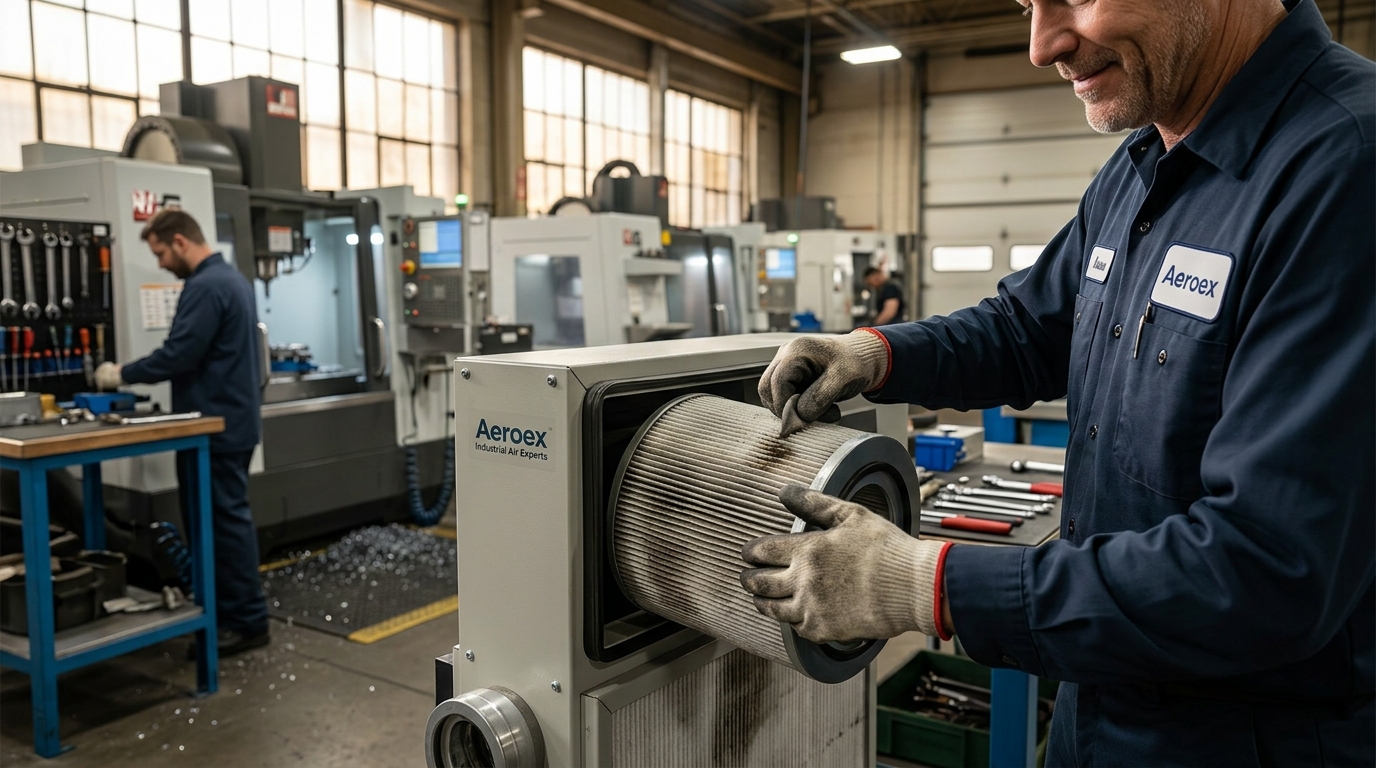
Filter replacement is the process of swapping spent filter media for new media to restore designed capture efficiency. Delaying replacements is one of the most common and costly mistakes facility managers make.
Understanding Filter Lifespans
Different filter stages have different service lives. For example, in the Aeroex ARO mist collector series, mechanical elements can last up to 20 years, agglomerator filters 10 to 15 years, and certified HEPA filters typically 2 to 4 years. The table below provides a general reference.
| Filter Stage | Type | Typical Lifespan | Key Function |
|---|---|---|---|
| 1st Stage | Mechanical Element | Up to 20 years | Separates up to 90% of oil mist and swarf |
| 2nd Stage | Depth-Loading Fiber Bed (MERV 13) | 1 to 3 years | Captures remaining mist with minimal blockage |
| 3rd Stage | Depth-Loading Fiber Bed (MERV 14) | 1 to 3 years | 25x more surface area than standard filters |
| 4th Stage | Certified HEPA Filter | 2 to 4 years | Captures 99.97% of submicron particles |
Signs You Need to Replace Sooner
Watch for increased pressure differential across the filter bank, visible mist escaping the unit, or unusual odors. If your system uses a progressive multi-stage filtration design, the first stage does the heavy lifting, which extends the life of downstream filters significantly.
Monitor System Performance Continuously
Monitoring filter performance allows for early detection of efficiency drops, prompting timely intervention before air quality deteriorates. Do not wait for a visible problem to take action.
Key Metrics to Track
Track static pressure across each filter stage using manometers or differential pressure gauges. Log airflow volume (CFM) at the inlet and outlet. Compare readings against baseline values taken when filters were new. A pressure drop exceeding 20% above baseline typically signals it is time for maintenance.
Leverage Technology
Modern systems offer integrated monitoring and maintenance alerts that indicate when replacement is needed. Variable frequency drives (VFDs) can also optimize airflow and extend filter life. Users who installed VFDs on Aeroex ARO units reported substantially improved filter longevity.
Stay Aligned with OSHA and EPA Requirements
Compliance is not optional. OSHA's 29 CFR 1910.1000 sets permissible exposure limits (PELs) for toxic particulates, capping the concentration workers can be exposed to during an 8-hour workday. A permissible exposure limit (PEL) is the maximum legal airborne concentration of a hazardous substance an employee can be exposed to over an 8-hour shift.
OSHA's hierarchy of controls places engineering solutions, such as industrial air purification systems, above administrative controls and PPE. Failing to meet standards can result in penalties up to $165,514 for willful violations as of January 2025. Regular air quality sampling confirms that your filtration systems are performing as intended.
Leverage Multi-Stage Filtration Technology
Multi-stage filtration is a design approach that uses sequential filter media of increasing efficiency to capture progressively smaller particles. This method dramatically reduces the maintenance burden on later, more expensive filter stages.
Systems like the Aeroex ARO-4000 remove 95% of mist particles in the first stage alone, which extends overall filter life and reduces maintenance costs. The progressive design means each stage handles a specific particle size range, preventing premature clogging that plagues single-stage systems.
When selecting or upgrading your filtration equipment, prioritize systems with accessible access points, user-friendly filter changes, and comprehensive documentation. These features minimize downtime during routine service and ensure that even operators with limited experience can perform maintenance tasks correctly.
Key Takeaways
- Establish weekly visual inspections and quarterly mechanical checks to prevent unexpected downtime.
- Replace filters according to manufacturer schedules; do not wait for visible failure.
- Track pressure differential and airflow metrics against baseline values for early problem detection.
- Maintain detailed logs of all maintenance activities for OSHA compliance documentation.
- Choose multi-stage filtration systems that protect expensive downstream filters by capturing the majority of contaminants early.
- Install VFDs to optimize airflow and extend filter service life.
- Partner with experienced filtration specialists for system audits and custom-engineered solutions.
Frequently Asked Questions
How often should I inspect my industrial air filtration system?
Perform visual checks weekly, mechanical inspections quarterly, and a full system review every six months. Adjust frequency based on production volume and contaminant load in your facility.
What are the signs that a filter needs replacing?
Rising pressure differential across the filter, visible mist or smoke escaping the unit, reduced airflow at the outlet, and unusual odors all indicate that filter media is saturated and needs replacement.
How long do HEPA filters last in industrial mist collectors?
In a well-maintained multi-stage system, HEPA filters typically last 2 to 4 years. Systems that capture the majority of particles in earlier stages, like the ARO series, extend HEPA life considerably.
Does OSHA require specific air filtration equipment?
OSHA does not certify or require specific equipment. Instead, it holds employers responsible for controlling worker exposure below permissible exposure limits using engineering controls as the preferred solution.
What is multi-stage filtration and why does it reduce maintenance?
Multi-stage filtration passes air through a sequence of filters with increasing efficiency. The first stages remove the bulk of contaminants, which prevents premature clogging of finer downstream filters, reducing replacement frequency and cost.
Can I use VFDs to improve filtration system efficiency?
Yes. Variable frequency drives allow you to adjust fan speed based on real-time demand, reducing energy consumption and extending filter life by avoiding unnecessary airflow that pushes contaminants deeper into filter media.
What documentation should I keep for compliance purposes?
Maintain records of inspection dates, filter replacements, pressure readings, airflow measurements, air quality sampling results, and employee training. OSHA requires employers to maintain exposure monitoring records for 30 years.
How do I choose the right filtration system for my facility?
Start by identifying the types of contaminants your process generates, then assess facility layout, ceiling height, and machine placement. Consult with a specialist who can recommend centralized or point-of-source solutions tailored to your operation. Aeroex offers a guide to choosing the right system for your needs.
Get Expert Help with Your Filtration Maintenance
Maintaining your industrial air filtration system does not have to be complicated. With over 20 years of experience manufacturing mist collectors and air purification systems, the Aeroex engineering team can assess your current setup, recommend optimizations, and provide ongoing support. Contact Aeroex today for a free consultation and experience the difference that properly maintained, high-performance filtration makes in your facility.