
Best Mist Collector for CNC Machining: How to Choose the Right System
CNC machining generates airborne oil mist, coolant mist, and smoke that threaten operator health, degrade equipment, and create slippery shop floors. A mist collector is a filtration device that captures these airborne contaminants at or near the source, returning clean air to the workspace. Choosing the best mist collector for your CNC operation depends on your machine type, coolant chemistry, airflow requirements, and shop layout. This guide breaks down every factor you need to evaluate so you can match the right system to your specific machining environment and keep your facility compliant with OSHA and NIOSH exposure limits.
Why Mist Collection Matters in CNC Shops
High-speed cutting, drilling, and grinding operations aerosolize metalworking fluids into fine droplets that linger in shop air. Prolonged inhalation of these mists is linked to respiratory disorders, skin irritation, and even occupational asthma. According to OSHA's Metalworking Fluids Best Practices Manual, the current permissible exposure limit (PEL) for mineral oil mist is 5 mg/m3 as an 8-hour time-weighted average. NIOSH recommends an even stricter limit of 0.5 mg/m3 total particulate.
Beyond health risks, uncontrolled mist settles on machine surfaces, electrical panels, and floors. This buildup accelerates wear on precision components, increases maintenance costs, and creates slip hazards. An effective metalworking mist collector addresses all of these concerns at once.
How CNC Mist Collectors Work
A CNC mist collector pulls contaminated air from inside the machine enclosure, passes it through multiple filtration stages, and returns clean air to the shop. The captured coolant or oil drains back to the machine sump, reducing fluid loss and cost. Multi-stage filtration is the process of separating contaminants in progressive steps so that no single filter bears the full load, which extends filter life and improves overall efficiency.
Common Filtration Stages
Most high-performance mist collectors use three or four stages. A mechanical pre-separator removes large droplets and swarf. A coalescing demister element captures medium-sized mist. A depth-loading fiber bed filter handles fine particles, often rated MERV 13 or higher. An optional HEPA final stage captures sub-micron particles for the cleanest possible exhaust.
Key Factors for Choosing a Mist Collector
Selecting the right mist collector is not one-size-fits-all. You need to evaluate several variables specific to your shop. Here are the most critical considerations when choosing a CNC mist collector.
Machine Type and Mist Load
Lathes and milling centers running high-pressure coolant generate heavy mist loads. Swiss-type screw machines using neat oil produce dense smoke at elevated spindle speeds. Your mist collector must be rated for the volume and type of aerosol your specific machine produces.
Coolant or Oil Chemistry
Coolant type is a key variable. Water-soluble emulsions, synthetic coolants, and straight oils each produce different particle sizes and concentrations. An oil mist collector and a coolant mist collector are not separate machines; they are the same filter platform configured for your fluid chemistry.
Airflow and Enclosure Design
Airflow capacity, measured in cubic feet per minute (CFM), must match or slightly exceed the air exchange rate of the machine enclosure. Undersized collectors allow mist to escape; oversized units waste energy. Enclosure design, including door seals and exhaust port locations, also affects performance.
Direct-Mount vs. Centralized Systems
Source capture is the practice of collecting contaminants directly at the point of generation, typically by mounting the collector on or immediately adjacent to the CNC machine. This approach eliminates the need for long duct runs, reduces installation costs, and delivers the highest capture efficiency. For shops exploring this approach, Aeroex provides detailed guidance on CNC mist extraction solutions.
Centralized systems use ductwork to pull air from multiple machines into a single large collector. They suit large facilities with many machines running identical processes. However, they require engineering design, balancing dampers, and more maintenance. Most small-to-mid-size CNC shops find direct-mount, point-of-source collectors more practical and cost-effective.
Mist-Fit: Compact Source Capture for Individual Machines
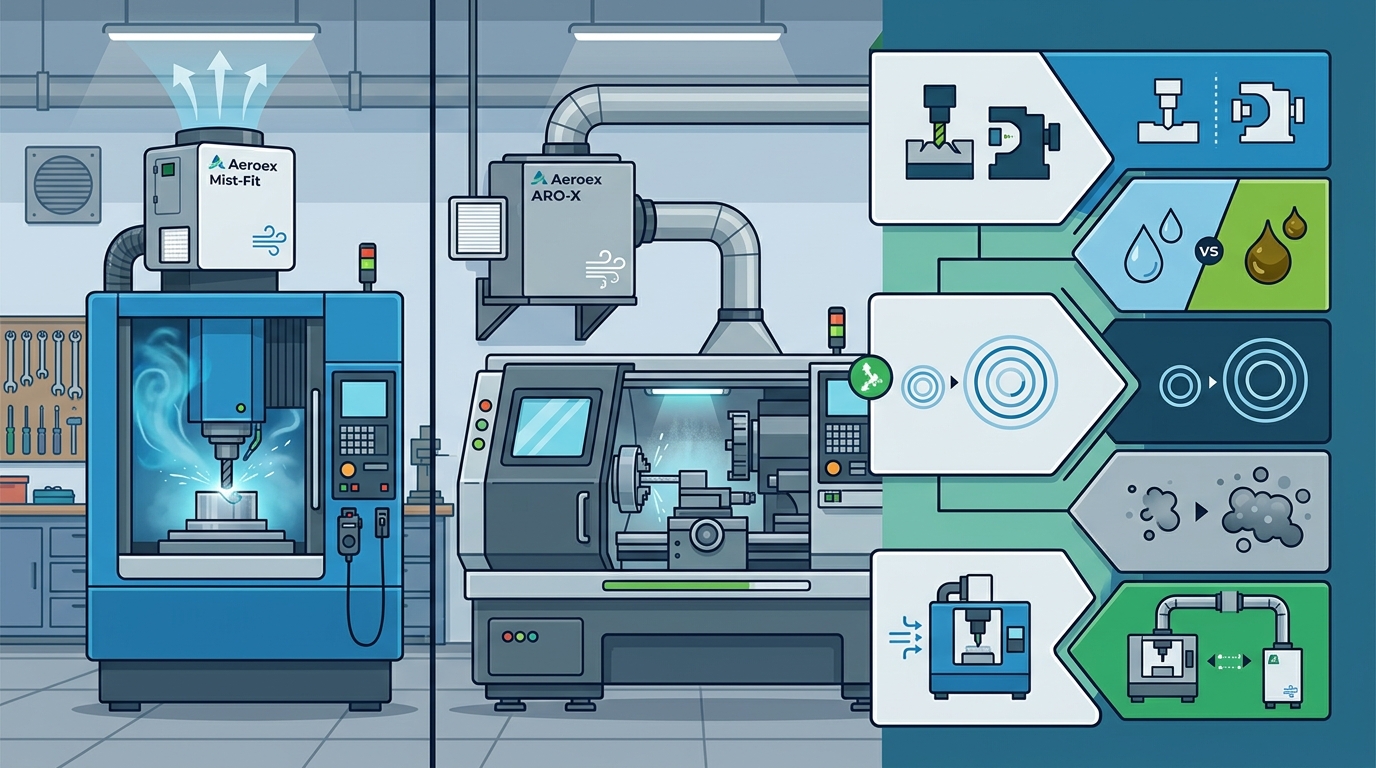
The Mist-Fit series from Aeroex is designed for direct-mount installation on individual CNC machines. With a footprint of just 25" x 25" and a weight of approximately 270 lbs, the Mist-Fit mounts directly on top of a machining center without requiring additional floor space or extensive ductwork.
Mist-Fit collectors use a multi-stage architecture: a mechanical element separates up to 90% of oil mist and swarf, a demister stage brings removal to 95%, and a depth-loading fiber bed filter rated MERV 15 handles the remaining fine particles. Filter life typically ranges from 1 to 3 years, and washable pre-filters keep ongoing maintenance costs low. The Mist-Fit is ideal for shops with limited floor space, compact machine layouts, or single-machine setups that need reliable source capture.
ARO: Multi-Stage Filtration for High-Demand Applications
When your application involves higher airflow requirements, multiple machines, or heavy smoke from high-speed operations, the ARO series provides a more robust solution. ARO collectors are available in configurations from 400 CFM up to 4,100 CFM, making them suitable for large machining centers and centralized collection from several machines.
The ARO uses a cross-flow filter design where airflow moves horizontally while captured oil drains vertically. Its mechanical element lasts up to 20 years, the agglomerator filter lasts 10 to 15 years, and HEPA filters typically last 2 to 4 years. This progressive multi-stage approach removes 95% of mist particles before air reaches the final filter, dramatically extending its service life. For complex or unique operating conditions, Aeroex also offers custom-engineered filtration solutions reviewed by their engineering team.
Mist-Fit vs. ARO: Side-by-Side Comparison
| Feature | Mist-Fit Series | ARO Series |
|---|---|---|
| Best For | Individual CNC machines, compact shops | High-demand, multi-machine, or centralized setups |
| Mounting | Direct machine mount | Floor-standing or elevated platform |
| Airflow Range | Up to ~550 CFM | 400 to 4,100 CFM |
| Filtration Stages | 3-stage (mechanical, demister, fiber bed MERV 15) | Up to 4-stage (mechanical, demister, fiber bed MERV 13, HEPA) |
| Filter Life (Primary) | 1 to 3 years | 2 to 4 years (HEPA); mechanical element up to 20 years |
| Ductwork Required | Minimal to none | May require ductwork for multi-machine setups |
| Ideal Coolant Types | Oil, soluble oil, synthetic coolant | Oil, soluble oil, synthetic coolant, heavy smoke |
Key Takeaways
- A mist collector is essential on any CNC machine running metalworking fluids to protect worker health and meet OSHA/NIOSH exposure limits.
- OSHA's PEL for mineral oil mist is 5 mg/m3 (8-hour TWA), while NIOSH recommends 0.5 mg/m3.
- Direct-mount, source-capture collectors like the Mist-Fit eliminate ductwork and maximize capture efficiency on individual machines.
- High-demand shops running multiple machines or heavy smoke applications benefit from the ARO series with airflow up to 4,100 CFM.
- Multi-stage filtration extends filter life by separating 90 to 95% of mist before it reaches the final filter element.
- Coolant type (oil, emulsion, or synthetic) does not require a separate collector; the same platform handles all three.
- Always match collector CFM to your machine enclosure air exchange rate for optimal performance.
Frequently Asked Questions
What is a mist collector?
A mist collector is a filtration system that removes airborne oil mist, coolant mist, and smoke generated during CNC machining. It pulls contaminated air from the machine enclosure, filters it through multiple stages, and returns clean air to the shop.
Are mist collectors required on CNC machines?
While not universally mandated by a single regulation, OSHA sets permissible exposure limits for oil mist at 5 mg/m3. If your shop exceeds these limits, engineering controls such as mist collectors are required before resorting to respiratory protection. Learn more about whether mist collectors are necessary for your operation.
How do I know what size mist collector I need?
Match the collector's CFM rating to your machine enclosure volume and air exchange rate. A collector that is too small will allow mist to escape, while an oversized unit wastes energy. Aeroex engineers can review your machine configuration and recommend the right size.
Can one mist collector handle both oil mist and water-based coolant mist?
Yes. Modern mist collectors like the Mist-Fit and ARO handle straight oil, soluble oil emulsions, and synthetic coolants on the same filter platform. No separate equipment is needed.
How often do mist collector filters need to be replaced?
It depends on the mist load and coolant type. Mist-Fit fiber bed filters typically last 1 to 3 years. ARO mechanical elements can last up to 20 years, with HEPA filters lasting 2 to 4 years. Washable pre-filters reduce the frequency of consumable replacements.
What is the difference between a direct-mount and a centralized mist collector?
A direct-mount mist collector attaches to a single CNC machine for source capture with minimal ductwork. A centralized system connects multiple machines through ductwork to one large collector. Direct-mount systems are simpler to install and maintain, while centralized systems suit large-scale operations.
Does a mist collector help with CNC machining smoke?
Yes. High-speed machining with neat oils often produces smoke composed of sub-micron particles. Multi-stage collectors with HEPA filtration, such as the ARO series, are specifically designed to capture these fine particles.
How do I maintain my mist collector?
Routine maintenance includes inspecting and washing pre-filters, checking drain lines, and monitoring airflow. For a full walkthrough, see the Aeroex guide on maintaining your mist collector for optimal performance.
Get Started With a Free Trial
Aeroex offers a 30- to 60-day free trial so you can evaluate mist collector performance in your actual machining environment. If the system does not meet your expectations, return it with no obligation. Request a consultation today and let the Aeroex engineering team recommend the best mist collector for your CNC shop.