
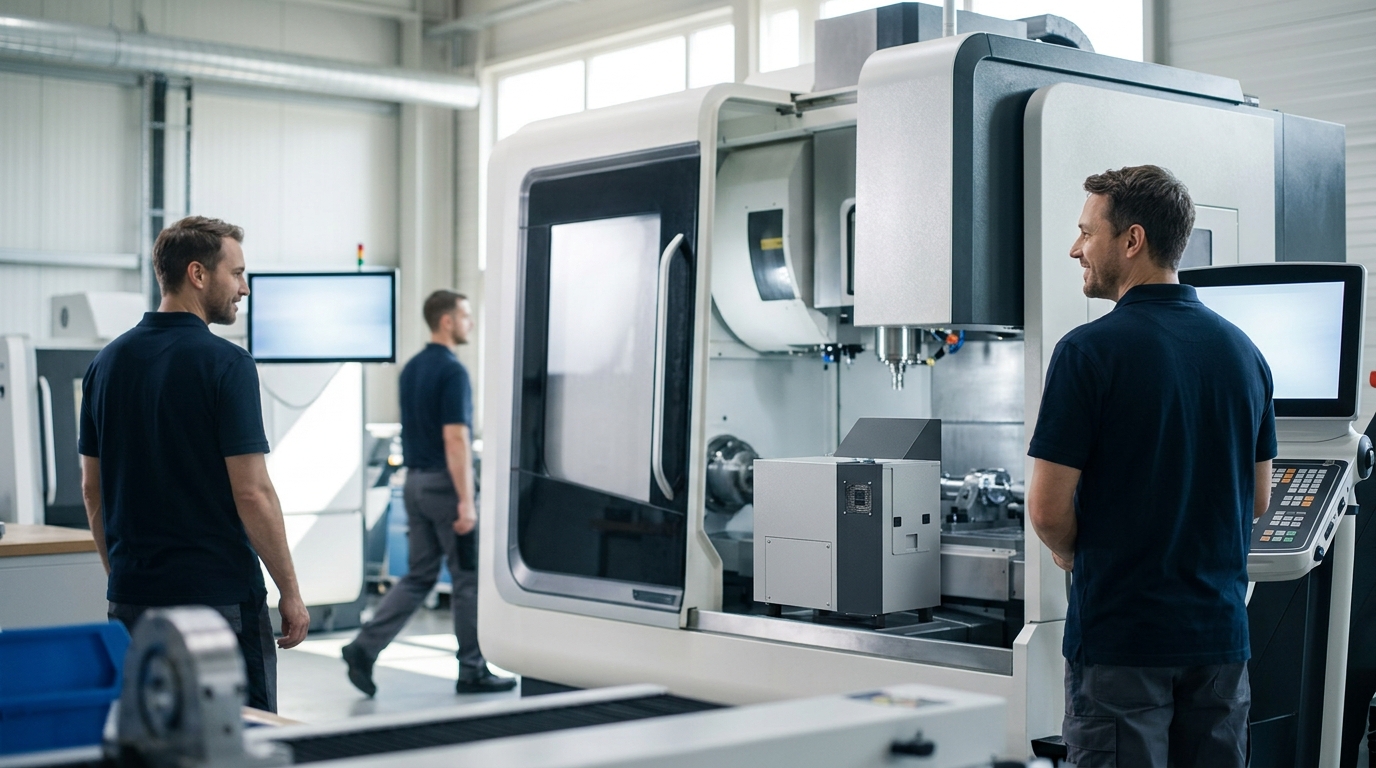
CNC machining generates airborne oil mist, coolant mist, and smoke that compromise operator health, degrade equipment, and put facilities at risk of regulatory citations. Choosing the right mist collector is one of the highest-impact decisions a machine shop can make. This guide breaks down what a mist collector actually does, the selection criteria that matter most, and which Aeroex product lines match specific shop configurations. Whether you run a single CNC lathe or a multi-machine production cell, you will find a clear path to cleaner air below.
What Is a CNC Mist Collector?
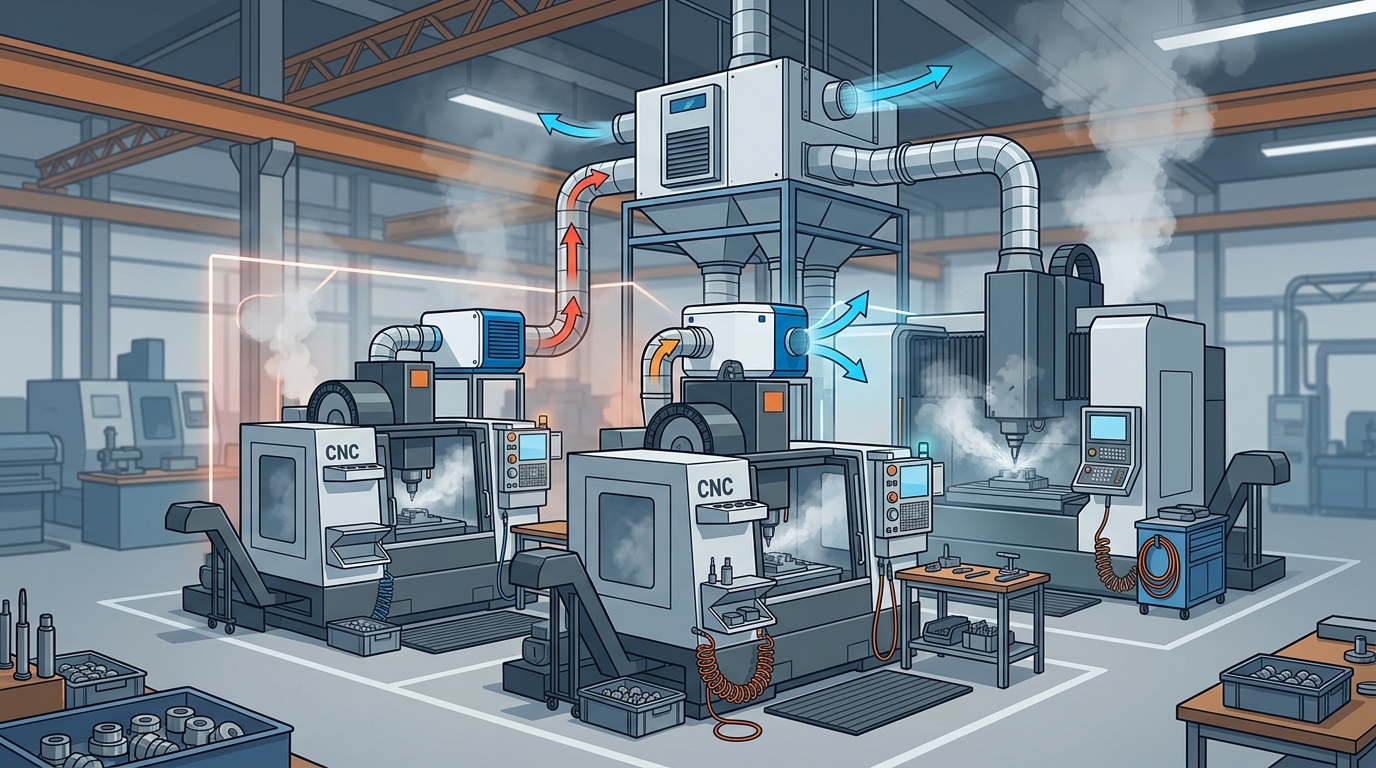
A mist collector is an air filtration device that captures oil mist, coolant mist, and submicron particulate generated during CNC machining. Mounted on or next to a CNC machine, it pulls contaminated air from inside the enclosure, separates liquid and particulate from the air stream, and returns clean air to the shop. Captured coolant drains back to the sump, reducing fluid loss and keeping floors dry.
An oil mist collector and a coolant mist collector are not separate machines. They are the same filter-based platform configured for your specific fluid chemistry, whether that is straight oil, soluble oil emulsion, or synthetic coolant. Learn more on the metalworking mist collectors application page.
Why Mist Collection Matters for Health and Compliance
Inhaling aerosolized metalworking fluids (MWFs) can lead to respiratory disorders, skin irritation, and long-term health problems. According to OSHA's Metalworking Fluids Best Practices Manual, the current permissible exposure limit (PEL) for mineral oil mist is 5 mg/m3 as an 8-hour time-weighted average. NIOSH recommends a far stricter limit of 0.5 mg/m3 total particulate, acknowledging that health effects can occur well below the enforceable PEL.
Beyond operator safety, uncontrolled mist settles on machine surfaces and electronics, accelerating wear and increasing maintenance costs. Facilities that invest in proper mist collection for CNC machines see benefits in equipment longevity, product quality, and regulatory readiness.
Key Selection Criteria for CNC Mist Collectors
Selecting the best mist collector depends on several factors unique to your operation. Use the criteria below to narrow options quickly.
Machine Type and Enclosure Design
Different CNC machines produce different mist loads. Lathes and milling centers generate heavy oil mist, while grinding operations can add fine smoke to the mix. The enclosure design determines how well mist is contained and how much airflow the collector must handle. Tightly enclosed machines are easier to capture from; open machines may need higher CFM ratings.
Coolant or Oil Type
Straight oils produce dense, oily aerosols that demand robust coalescing filtration. Water-soluble coolants generate lighter mist but can promote bacterial growth if not properly managed. Your fluid chemistry directly influences filter selection and maintenance intervals.
Floor Space and Mounting Constraints
Shops with limited floor space benefit from direct-mount, machine-mounted mist collectors that eliminate ductwork and free up valuable real estate. Larger facilities running multiple machines may prefer a centralized or engineered filtration system reviewed by application engineers.
Direct-Mount vs. Engineered Mist Collection Systems
A direct-mount mist collector is a compact unit installed directly on a single CNC machine for source capture. It is the best fit when you have individual machines, compact layouts, or want to minimize ductwork and installation complexity. The Aeroex Mist-Fit series is purpose-built for this scenario, with a footprint as small as 25" x 25" and easy machine mounting.
An engineered mist collection system is a custom-configured solution designed for complex applications with higher airflow requirements, multiple machines, or unique operating conditions involving oil mist, coolant mist, smoke, vapor, and process contaminants. The Aeroex ARO series serves these higher-demand applications with progressive multi-stage filtration and models ranging from 400 CFM to 4,000 CFM.
Aeroex Product Line Comparison
The table below summarizes key differences across the Aeroex mist collector families to help you match a product to your shop's needs.
| Feature | Mist-Fit Series | ARO Series |
|---|---|---|
| Best For | Single CNC machines, compact layouts | High-mist environments, multi-machine setups |
| Mounting | Direct machine mount | Floor-standing or system-integrated |
| Filtration Stages | 3-stage (mechanical, demister, fibre bed) | Up to 4-stage (mechanical, demister, fibre bed, HEPA) |
| Fibre Bed Rating | MERV 15 | MERV 13 + optional HEPA (99.97%) |
| Filter Life | 1 to 3 years (fibre bed) | Mechanical element up to 20 years; HEPA 2 to 4 years |
| Fluid Compatibility | Oil, soluble oil, synthetic coolant | Oil, soluble oil, synthetic coolant |
| Noise Level | Low | As low as 69 dB(A) |
| Trial Available | Yes, 30 to 60 days | Yes, 30 to 60 days |
Both product lines drain captured fluid back to the CNC machine sump, reducing coolant replacement costs.
How Multi-Stage Filtration Works
Multi-stage filtration is a design approach that separates contaminants in progressive steps, preventing premature filter loading and extending overall filter life.
Stage 1: Mechanical Separation
An innovative mechanical element separates up to 90% of oil mist and swarf. Smooth metal surfaces drain fluid quickly back to the sump, protecting downstream filters.
Stage 2: Demister Element
The demister supports the first stage to remove up to 95% of remaining mist with washable, non-consumable filters. This drastically reduces the load on final-stage media.
Stage 3: Depth-Loading Fibre Bed or HEPA
A depth-loading coalescing fibre bed filter captures fine mist particles. In ARO models, an optional certified HEPA filter captures 99.97% of submicron particles, including smoke. This final polish delivers air quality that meets or exceeds OSHA and NIOSH guidelines for metalworking fluid exposure.
Key Takeaways
- A mist collector is essential on every CNC machine to protect operators from oil mist, coolant mist, and smoke exposure.
- OSHA's PEL for mineral oil mist is 5 mg/m3; NIOSH recommends the stricter 0.5 mg/m3 limit.
- Match the collector to your machine type, coolant chemistry, enclosure design, and floor space constraints.
- The Mist-Fit series is ideal for direct-mount, single-machine source capture in compact shop layouts.
- The ARO series handles high-mist, multi-machine, and engineered applications with up to four filtration stages.
- Multi-stage filtration extends filter life by removing up to 95% of contaminants before the final filter stage.
- Aeroex offers a 30 to 60 day free trial so you can validate performance before committing.
Frequently Asked Questions
What is the best mist collector for a small CNC shop?
For small shops with one to five machines and limited floor space, a direct-mount collector like the Aeroex Mist-Fit is typically the best choice. It mounts directly to the machine, requires no ductwork, and provides effective source capture of oil and coolant mist.
Do I need a mist collector on every CNC machine?
While regulations vary, OSHA requires employers to keep airborne metalworking fluid concentrations below the PEL. Installing a mist collector on each enclosed CNC machine is the most reliable way to achieve compliance and protect operators.
How often do mist collector filters need replacing?
It depends on the system. In the ARO series, the mechanical element can last up to 20 years, the agglomerator filter 10 to 15 years, and HEPA filters 2 to 4 years. The Mist-Fit fibre bed filter typically lasts 1 to 3 years depending on mist load.
Can the same mist collector handle oil mist and coolant mist?
Yes. Oil mist and coolant mist collectors use the same filter-based platform. Whether your sump runs straight oil, soluble oil emulsion, or synthetic coolant, a properly configured Aeroex mist collector handles all three.
What is the difference between a mist collector and a smoke collector?
Smoke consists of submicron thermal decomposition particles, while mist consists of larger aerosolized liquid droplets. High-quality mist collectors with HEPA final stages, like the ARO series, capture both mist and smoke effectively.
How do I know what CFM rating I need?
The required airflow depends on your machine enclosure volume and the rate of mist generation. Aeroex engineers review your machine configuration and recommend the appropriate CFM. You can start by exploring the selection guide to understand the variables involved.
Does Aeroex offer a trial period?
Yes. Aeroex provides a 30 to 60 day free trial on its mist collectors. If you are not satisfied with performance, you can return the unit with no obligation.
Get Started with a Free Trial
The best way to find the right mist collector for your CNC machines is to test one in your actual production environment. Aeroex offers a no-risk, 30 to 60 day trial on both the Mist-Fit and ARO product lines. Explore the full product lineup and request your free trial today to experience cleaner air, healthier operators, and lower maintenance costs firsthand.