
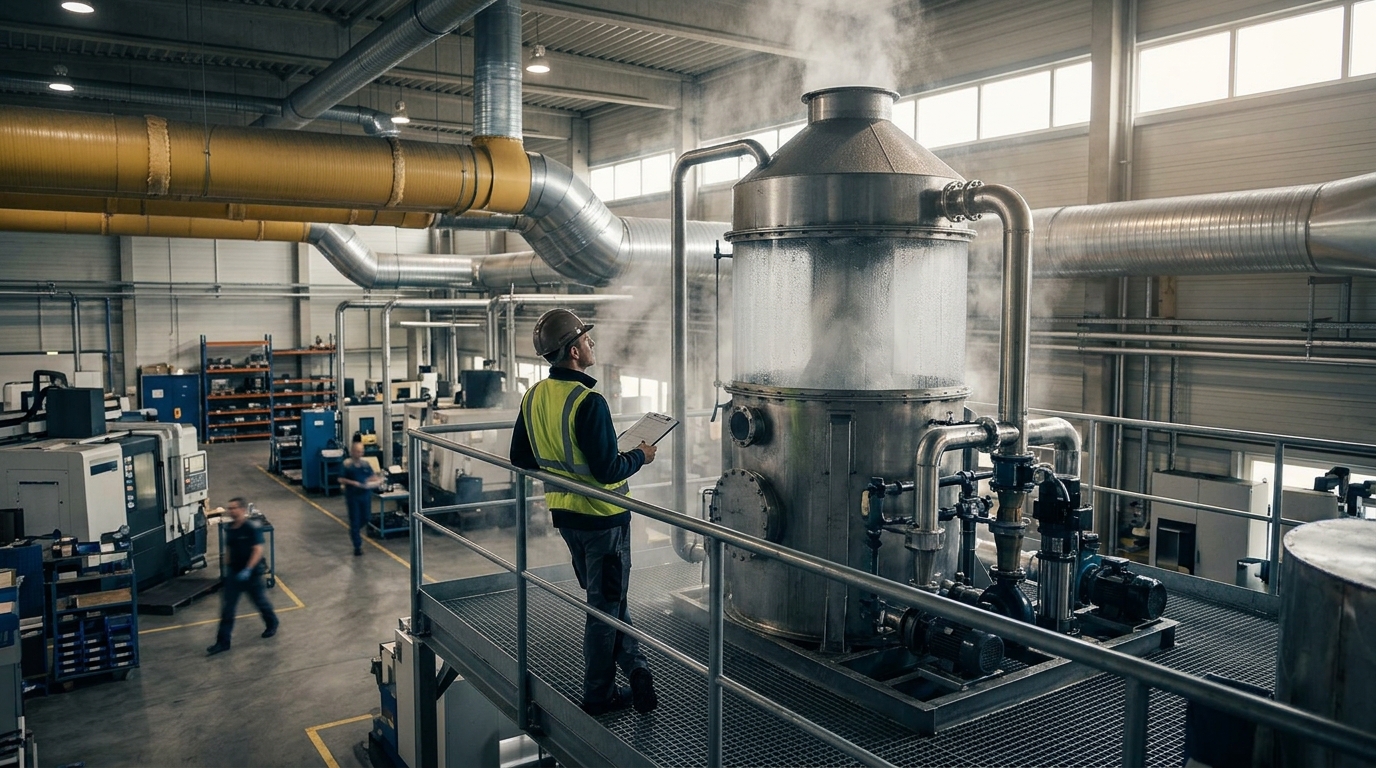
Wet scrubbers are not always the right choice for factory air quality needs. They are highly effective for removing large particulates and soluble gases but often create secondary waste streams and require complex water treatment. For many modern manufacturing environments, particularly those dealing with oil mist and coolant aerosols, dry mist collection systems offer a cleaner, more efficient, and lower-maintenance alternative that captures contaminants at the source without generating liquid waste.
Understanding Wet Scrubber Technology
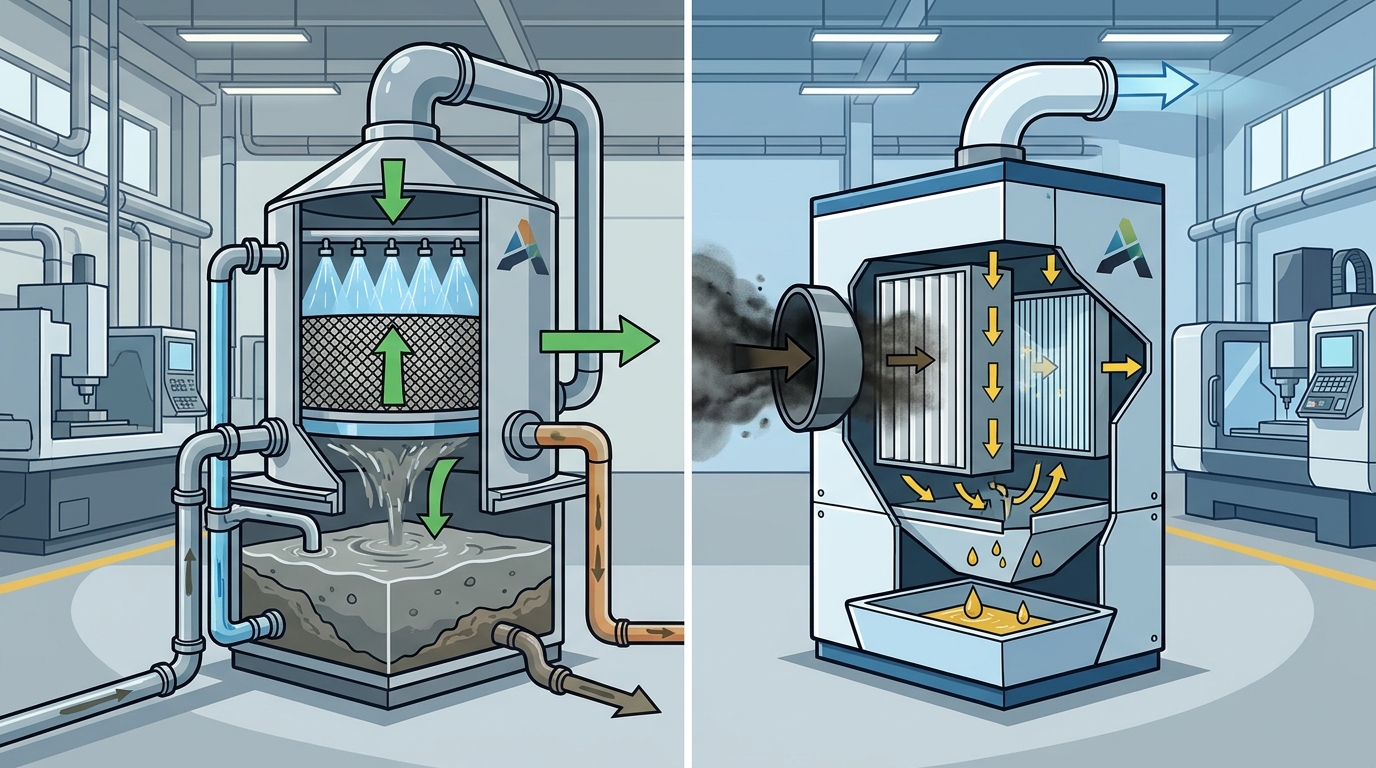
A wet scrubber is an air pollution control device that uses a liquid, typically water, to remove particulate matter and gases from an industrial gas stream. The process involves forcing contaminated air through a chamber where it contacts the liquid medium. As the air passes through, contaminants are absorbed, dissolved, or physically captured by the liquid. This technology has been a staple in heavy industry for decades due to its ability to handle high volumes of dirty air. according to Monitoring by Control
The core mechanism relies on the physical properties of the contaminants. Water-soluble gases, such as sulfur dioxide or hydrogen chloride, dissolve readily into the scrubbing liquid. Particulate matter is captured through impaction, interception, or diffusion as the liquid droplets collide with the solid particles. While effective for these specific types of pollutants, the technology is less efficient for non-soluble oils and hydrocarbons, which can form emulsions that are difficult to separate and dispose of.
Limitations in Modern Manufacturing Environments
In contemporary machine shops and light manufacturing facilities, the primary airborne contaminants are often oil mist, coolant mist, and fine smoke generated by CNC machining and grinding. Wet scrubbers face significant challenges in these environments. Oil and coolant are hydrophobic, meaning they do not dissolve in water. Instead, they form stable emulsions that require chemical breaking agents and specialized separation equipment to treat. This creates a continuous stream of hazardous waste that must be managed, transported, and disposed of at significant cost.
Furthermore, wet scrubbers require a constant supply of clean water and a robust drainage system. The water used in the scrubbing process becomes contaminated and must be recirculated or discharged. If discharged, it must meet strict environmental regulations regarding pH, temperature, and chemical content. This adds operational complexity and regulatory risk. For facilities with limited water resources or strict discharge limits, wet scrubbers can become a liability rather than an asset.
The Case for Dry Mist Collection
Dry mist collection systems, such as those engineered by Aeroex, offer a distinct advantage by capturing contaminants without the use of water. These systems utilize progressive filtration stages, including coalescing media and HEPA filters, to separate liquid mist and solid particles from the air stream. The captured oil and coolant are drained back into the machine sump or collected in a container for disposal, eliminating the need for water treatment and hazardous liquid waste management.
For CNC machining applications, source capture is critical. Dry mist collectors can be mounted directly on the machine enclosure, capturing contaminants before they escape into the shop environment. This approach, often referred to as point-of-source collection, is more efficient than trying to clean the entire room air. It reduces the total volume of air that needs to be filtered, leading to lower energy consumption and smaller equipment footprints. Aeroex’s Mist-Fit series is designed specifically for these compact, direct-mount applications, providing high-efficiency capture in a small package.
When Wet Scrubbers Are the Right Choice
Despite the advantages of dry collection, wet scrubbers remain the preferred solution for specific industrial processes. They are ideal for applications involving high concentrations of water-soluble gases, such as chemical processing, acid gas removal, or certain types of combustion exhaust. In these scenarios, the ability to dissolve and neutralize the contaminants in a liquid medium is a key benefit. Wet scrubbers can also handle very high air volumes and large particulate loads more effectively than dry systems, making them suitable for heavy industrial processes like cement production or steel manufacturing.
However, for the majority of metalworking, machining, and light manufacturing facilities, the balance of efficiency, cost, and environmental impact favors dry mist collection. The decision should be based on a detailed analysis of the contaminant profile, air volume, and facility constraints. If your primary concern is oil mist, coolant aerosols, or fine smoke from machining, a dry system is likely the more appropriate and cost-effective choice.
Key Takeaways
- Wet scrubbers are effective for removing water-soluble gases and large particulates but create secondary liquid waste.
- Dry mist collection systems are better suited for oil mist, coolant mist, and machining smoke, as they avoid water treatment.
- Source capture with dry collectors reduces energy consumption and equipment size compared to room air cleaning.
- Wet scrubbers require complex water management and regulatory compliance for discharge.
- Dry systems like Aeroex’s Mist-Fit and ARO-X offer lower maintenance and no hazardous liquid waste.
- The choice between wet and dry systems depends on the specific contaminant profile and facility constraints.
Frequently Asked Questions
What is the main difference between wet scrubbers and dry mist collectors?
The main difference is the medium used for capture. Wet scrubbers use liquid to absorb or capture contaminants, creating a liquid waste stream. Dry mist collectors use filter media to separate contaminants from the air, resulting in no liquid waste.
Are wet scrubbers better for oil mist?
No, wet scrubbers are generally less effective for oil mist because oil does not dissolve in water. Dry mist collectors are specifically designed to coalesce and drain oil mist, making them a better fit for machining applications.
Do wet scrubbers require a lot of maintenance?
Yes, wet scrubbers require regular maintenance of the water system, including pH adjustment, chemical dosing, and sludge removal. Dry mist collectors typically require only periodic filter inspection and replacement.
Can dry mist collectors handle high air volumes?
Yes, dry mist collectors can be engineered to handle high air volumes. Aeroex offers systems like the ARO-X series that are designed for heavy-duty applications with high airflow requirements.
Is a wet scrubber required for regulatory compliance?
Not necessarily. Regulatory compliance depends on the type and concentration of contaminants. For many machining operations, dry mist collection is sufficient to meet air quality standards without the need for a wet scrubber.
Conclusion
Selecting the right air quality solution requires a clear understanding of your specific contaminants and operational constraints. While wet scrubbers have their place in heavy industry, they are often overkill and inefficient for modern machining and light manufacturing environments. Dry mist collection systems provide a targeted, efficient, and environmentally friendly approach to managing oil mist, coolant aerosols, and smoke. By capturing contaminants at the source, these systems improve workplace air quality, protect equipment, and reduce maintenance burdens. For facilities looking to optimize their air quality strategy, a detailed assessment of their specific needs is the first step. To discuss your facility's requirements and explore the right solution, .