
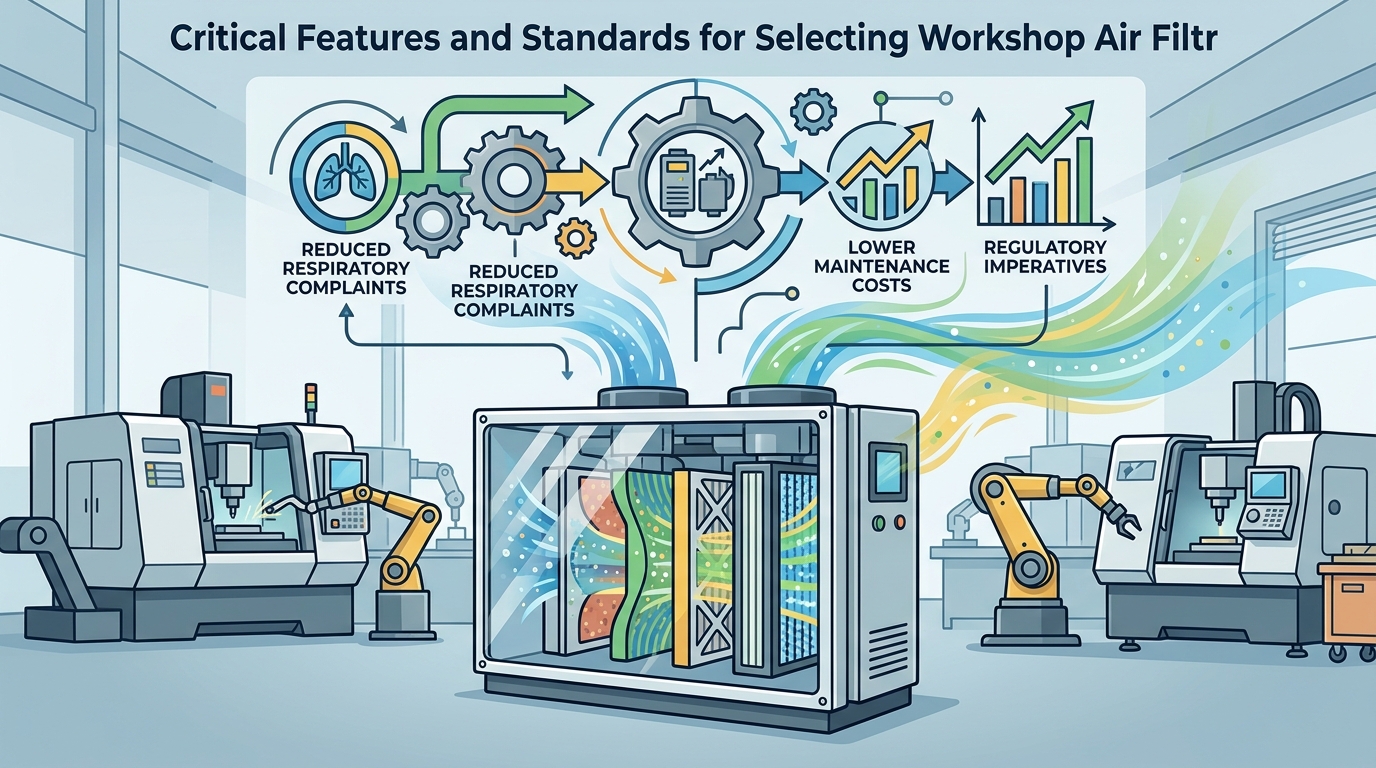
Critical Features and Standards for Selecting Workshop Air Filtration Systems
Industrial air quality is no longer just a comfort metric; it is a regulatory imperative. According to recent occupational safety data, manufacturing facilities that implement advanced air purification systems see a measurable reduction in respiratory complaints and equipment maintenance costs. Aeroex has been a trusted North American air purification expert since 2001, helping over 1,000 manufacturing facilities globally meet rigorous air quality standards. This guide details the critical features, technical standards, and selection criteria you must evaluate to protect your workforce and optimize your operational efficiency. (Contact Aeroex Emission Control)
Understanding Industrial Air Filtration
Workshop air filtration systems are engineered to remove harmful particulates, oils, and odors from the breathing zone of operators and the general facility environment. Metalworking, CNC machining, and assembly operations generate significant amounts of oil mist, smoke, and dust. Without proper extraction, these contaminants settle on machinery, reducing precision and increasing downtime. They also pose serious health risks to employees, including lung damage and chronic respiratory issues.
Aeroex Technologies was established in 2001 in Barrie, Ontario, with a mission to transform industrial environments through advanced air purification technology. Over two decades, the company has evolved from a modest 2,400-square-foot workshop to a 15,000-square-foot facility, expanding its product lines to include the Maverick, Mist-Fit, ARO-X, and IRIS series. This history of innovation underscores the importance of selecting a partner with deep industry expertise.
Oil mist is a suspension of fine oil droplets in the air. These droplets are created during machining processes such as grinding, milling, and turning. If not captured, oil mist can create slippery floors, leading to safety hazards, and can interfere with subsequent processes like painting or welding. Effective filtration systems must capture these droplets before they disperse into the workshop atmosphere.
Key Filtration Standards and Efficiency
When selecting a filtration system, understanding efficiency ratings is paramount. The standard for measuring the performance of air filters is the MERV (Minimum Efficiency Reporting Value) scale. However, for industrial applications involving fine particulates and oil mists, HEPA (High-Efficiency Particulate Air) standards are often the benchmark.
Aeroex systems are designed to remove 99.9% of harmful particles from the air. This high level of efficiency is critical for maintaining cleanroom standards in inspection areas and ensuring the longevity of sensitive electronic components in assembly lines. The dual-stage filtration approach used in the IRIS series, for example, combines a MERV8/Carbon primary filter with a HEPA secondary filter. This configuration ensures that large particulates are captured first, protecting the HEPA filter and extending its life, while the carbon layer addresses odor control.
Energy efficiency is another critical standard. Variable Frequency Drives (VFDs) allow filtration units to adjust their airflow based on real-time demand. This not only reduces energy consumption but also significantly extends filter life. By lowering the fan speed when full capacity is not required, VFDs reduce the stress on the filter media, preventing premature clogging and maintaining consistent airflow performance over time.
Evaluating Filtration Technologies
Different workshop environments require different filtration technologies. The three primary technologies used in industrial air purification are mechanical filtration, electrostatic precipitation, and centrifugal separation. Each has distinct advantages depending on the type of contaminant and the scale of the operation.
Mechanical Filtration
Mechanical filtration relies on physical barriers to trap particles. This is the most common method for oil mist collection. The air is forced through a series of filters that capture contaminants based on size. Aeroex’s ARO-X series utilizes advanced mechanical filtration to capture fine oil mist and smoke. These units are designed for easy maintenance, allowing operators to replace filters quickly without specialized tools.
Electrostatic Precipitation
Electrostatic precipitators use a high-voltage electric field to charge particles, which are then attracted to and collected on oppositely charged plates. This technology is highly effective for fine particulates and can be more energy-efficient than mechanical filtration for certain applications. However, it requires regular cleaning of the collection plates to maintain efficiency.
Centrifugal Separation
Centrifugal separation uses rotational force to throw heavier particles against the walls of a chamber, where they collect and drain away. This method is often used as a pre-filter stage to remove larger droplets before the air enters the mechanical filtration stage. This extends the life of the primary filters and reduces maintenance costs.
System Design and Airflow Dynamics
The physical design of the filtration system must match the specific layout and operational needs of the workshop. Key factors include airflow volume, static pressure, and capture velocity.
Airflow volume is measured in cubic feet per minute (CFM). The system must be sized to handle the volume of air generated by the machinery and the ventilation requirements of the space. Aeroex offers engineered solutions that are customized to the specific CFM needs of each facility. This ensures that the system is neither underpowered, leading to poor air quality, nor oversized, leading to unnecessary energy costs.
Static pressure refers to the resistance the fan must overcome to move air through the filters and ductwork. Systems with high-efficiency filters have higher static pressure requirements. It is crucial to select a fan that can maintain adequate airflow even at high static pressures. Aeroex’s Mist-Fit series is designed for compact spaces, offering high performance in a small footprint while maintaining the necessary static pressure to capture mist at the source.
Capture velocity is the speed at which air must be drawn into the capture point to prevent contaminants from escaping. For oil mist collectors, this velocity must be sufficient to pull the mist from the machining zone before it disperses. The BlowBox, for instance, is a compact, dual downdraft blow-off station that captures hazardous mist during part blow-off with compressed air. This targeted approach ensures that contaminants are captured at the source, minimizing the volume of air that needs to be filtered.
Product Comparison Guide
Selecting the right Aeroex product depends on your specific application. The table below compares the key features of our primary product lines to help you make an informed decision.
| Product Line | Primary Application | Filtration Technology | Key Benefit |
|---|---|---|---|
| Maverick | General Workshop Air Purification | Multi-stage Mechanical | High-capacity removal of smoke and mist |
| Mist-Fit | Machine Tool Oil Mist Collection | Compact Mechanical | Space-saving design for individual machines |
| ARO-X | Heavy-Duty Oil Mist and Smoke | Advanced Mechanical | Easy maintenance and high efficiency |
| Blow Box | Part Blow-Off Capture | Dual Downdraft | Source capture of mist during cleaning |
| Air-Fit | General Ventilation | Filtration | Flexible installation options |
| IRIS | Clean Rooms and Odor Control | Dual-Stage (MERV8/Carbon + HEPA) | High-performance odor and particle removal |
For metalworking applications, the ARO-X series is often the preferred choice due to its robust construction and high filtration efficiency. For facilities with space constraints, the Mist-Fit series provides a compact solution that can be mounted directly to the machine tool. If your facility requires cleanroom standards for inspection areas, the IRIS series offers the dual-stage filtration necessary to meet these rigorous requirements.
Key Takeaways
- Established Expertise: Aeroex has been a leader in industrial air purification since 2001, with a history of continuous innovation and expansion.
- High Efficiency: Aeroex systems are engineered to remove 99.9% of harmful particles, ensuring compliance with strict air quality standards.
- Trusted by Industry: Over 1,000 manufacturing facilities globally trust Aeroex for their air purification needs, including CNC machine shops and cleanrooms.
- Comprehensive Product Range: From the compact Mist-Fit to the high-capacity ARO-X, Aeroex offers solutions for every workshop environment.
- Energy Efficiency: The use of VFDs in Aeroex systems extends filter life and reduces energy consumption, lowering total cost of ownership.
- North American Presence: With operations in Barrie, Ontario, and the recent launch of Aeroex U.S.A., the company provides robust support across North America.
- Customer-Centric Values: Aeroex’s core values of quality, responsiveness, and integrity ensure a seamless experience from initial consultation to installation and beyond.
Frequently Asked Questions
What is the difference between MERV and HEPA filtration?
MERV (Minimum Efficiency Reporting Value) measures the effectiveness of air filters in removing particles from the air. HEPA (High-Efficiency Particulate Air) is a stricter standard that requires filters to remove at least 99.97% of particles that are 0.3 microns in diameter. Aeroex uses both MERV and HEPA filters in different product lines to meet varying levels of air quality requirements.
How often do I need to replace the filters in an Aeroex system?
Filter replacement frequency depends on the type of contaminants and the volume of air being processed. Aeroex systems are designed for easy maintenance, and the use of VFDs can extend filter life by reducing the load on the filter media. Regular inspection is recommended to determine the optimal replacement schedule.
Can Aeroex systems be used in cleanrooms?
Yes, the IRIS series is specifically designed for cleanrooms and inspection areas. It features a dual-stage filtration system with a MERV8/Carbon primary filter and a HEPA secondary filter, providing high-performance odor control and particle removal.
What is the Blow Box and how does it work?
The Blow Box is a compact, dual downdraft blow-off station that captures hazardous mist during part blow-off with compressed air. It is designed to capture contaminants at the source, preventing them from dispersing into the workshop environment.
Does Aeroex offer custom engineering solutions?
Yes, Aeroex provides engineered solutions tailored to the specific needs of each facility. This includes custom airflow calculations, static pressure analysis, and system design to ensure optimal performance and efficiency.
How does Aeroex support its customers?
Aeroex is committed to customer experience and responsiveness. The company offers comprehensive support from the initial site visit and quoting process to installation and ongoing maintenance. Their team is available to assist with any technical questions or service needs.
What areas does Aeroex serve?
Aeroex serves manufacturing facilities across North America. With the recent launch of Aeroex U.S.A., the company has expanded its reach to provide localized support and service to customers in the United States.
Contact Us
Ready to improve your workshop air quality? Contact Aeroex today to discuss your specific needs and explore our range of industrial air filtration solutions. Our team of experts is ready to provide a customized quote and guide you through the selection process. Visit our Contact Us page or call 1-866-392-9222 to get started.