
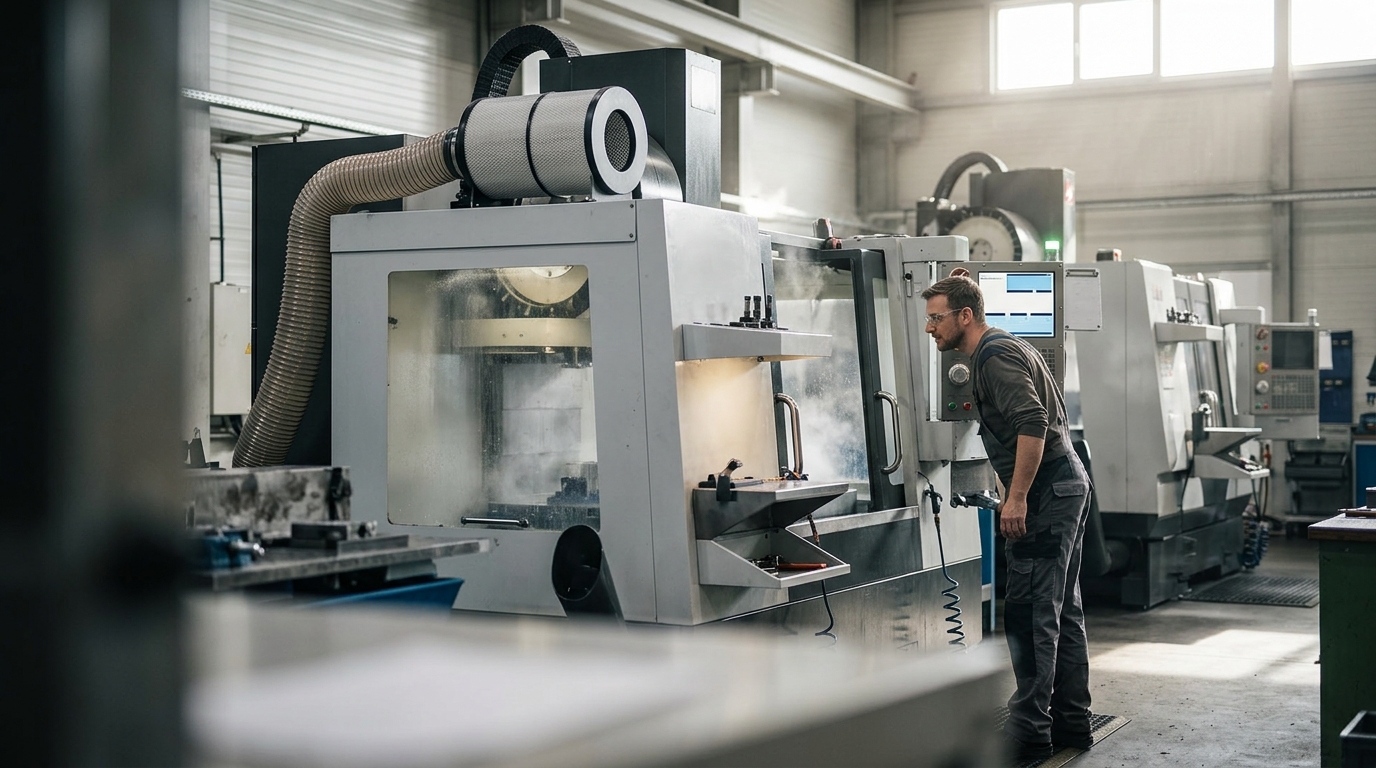
Source capture ventilation prevents factory mist problems by extracting airborne contaminants at the point of generation. Instead of diluting the entire room, it uses localized suction to pull oil mist, coolant vapor, and smoke directly from the machine enclosure. This approach significantly reduces operator exposure and prevents mist from settling on surfaces. Aeroex designs these systems to integrate seamlessly with industrial machinery, ensuring that the air leaving the source is clean before it enters the broader facility. For additional details, review the Contact Aeroex Emission Control.
The Mechanics of Localized Extraction
Source capture ventilation is a process that removes pollutants at their origin rather than relying on general room air exchange. In a typical CNC machining environment, high-speed cutting generates a dense cloud of submicron particles and liquid droplets. If left unmanaged, this mist disperses into the shop floor, creating a hazardous and slippery environment. By placing an intake hood or direct-mount collector at the machine opening, the system creates a negative pressure zone. This zone captures the mist before it can escape the enclosure. The captured air is then drawn through a filtration train, separating the liquid and particulate matter from the clean air stream.
The efficiency of this process depends on the velocity of the air at the capture point. A well-designed system ensures that the airflow is strong enough to overcome the momentum of the generated mist. This is particularly critical during high-load operations where the volume of generated vapor increases. By focusing on the source, the system requires less total airflow to achieve the same level of air quality compared to room-level ventilation. This results in lower energy consumption and reduced strain on the facility's HVAC infrastructure.
Direct-Mount Solutions for Compact Layouts
The Mist-Fit uses a multi-stage filtration approach to handle various coolant types. It captures the bulk of the liquid droplets in a pre-filter stage, while a high-efficiency filter handles the finer submicron particles. This configuration is ideal for compact machine layouts where source capture is the primary goal. The direct connection to the machine ensures that the mist is captured at the highest concentration point. This reduces the risk of mist escaping into the operator's breathing zone. The compact design also simplifies maintenance, as filters are easily accessible for replacement.
Engineered Systems for Complex Demands
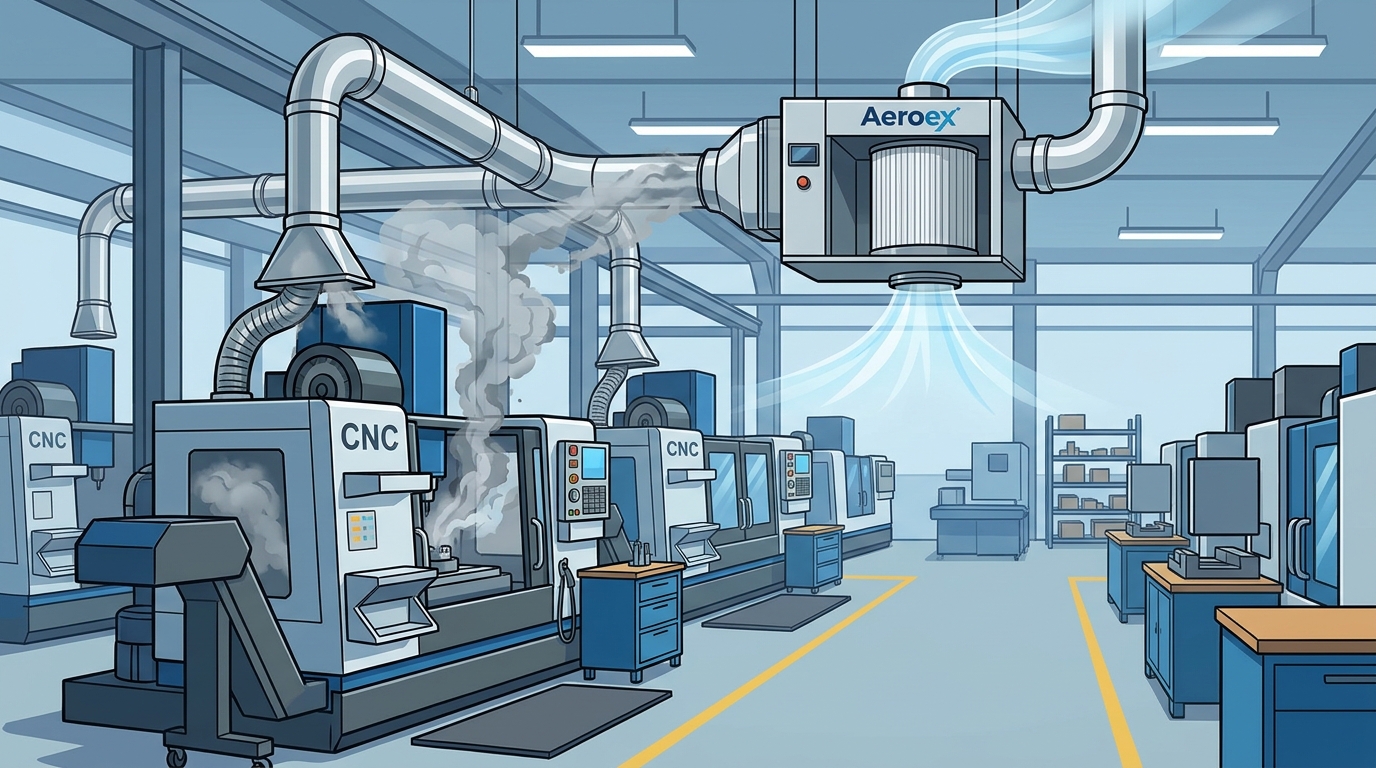
When a facility operates multiple machines or handles complex process contaminants, a modular engineered system is often required. The ARO-X is a scalable filtration platform designed for higher airflow requirements and multi-stage filtration needs. It is a strong fit for applications involving oil mist, coolant mist, smoke, and volatile organic compounds. The system can be configured with stainless steel or coated steel housings to suit specific environmental conditions. This flexibility allows for custom-tailored solutions that address unique operating challenges.
The ARO-X platform supports a wide range of applications, from standard machining to specialized processes. It can be equipped with activated carbon filters to capture odors and chemical vapors. This is particularly useful in environments where synthetic coolants or chemical processes generate strong smells. The modular design allows for easy expansion as the facility grows. By using a single, robust platform, facilities can maintain consistent air quality across multiple workstations. This approach simplifies maintenance and ensures that all machines are protected by the same high standard of filtration.
Stainless Steel for Corrosive Environments
The corrosion resistance of stainless steel extends the lifespan of the filtration system. In environments where standard steel would rust and fail, stainless steel maintains its structural integrity. This is essential for maintaining consistent airflow and filtration efficiency over time. The smooth surfaces of stainless steel also make cleaning easier, supporting the sanitary requirements of food production. By selecting the appropriate material, facilities can ensure that their air filtration systems remain reliable and effective in challenging conditions.
Key Takeaways
- Source capture ventilation removes contaminants at the point of generation, reducing operator exposure and energy use.
- Direct-mount units like the Mist-Fit are ideal for compact layouts and individual machine protection.
- Modular systems like the ARO-X offer scalability for multi-machine facilities and complex contaminant profiles.
- Stainless steel construction is recommended for corrosive, humid, or sanitary environments.
- Proper airflow velocity at the capture point is essential for effective mist containment.
- Multi-stage filtration ensures that both liquid droplets and submicron particles are removed.
- Custom engineering allows for tailored solutions that match specific process requirements.
Frequently Asked Questions
What is the main advantage of source capture over room ventilation?
Source capture removes contaminants before they disperse into the room, requiring less airflow and providing better protection for operators.
Can a direct-mount collector handle high-volume mist generation?
Yes, provided the unit is sized correctly for the machine's airflow requirements and mist load.
Why is stainless steel used in some mist collectors?
Stainless steel resists corrosion from moisture and chemicals, making it suitable for washdown and sanitary environments.
How does multi-stage filtration work in these systems?
It uses a sequence of filters to capture large droplets first, followed by finer particles, ensuring high overall efficiency.
Is source capture suitable for all types of industrial mist?
It is effective for oil mist, coolant mist, and smoke, but the specific configuration depends on the contaminant type.
How often should filters be replaced in a source capture system?
Replacement frequency depends on the mist load and operating hours, but regular monitoring is recommended to maintain performance.
Conclusion
Source capture ventilation is a critical strategy for managing factory mist problems. By focusing on the point of generation, it offers a more efficient and effective solution than general room ventilation. Aeroex provides a range of systems, from compact direct-mount units to large modular platforms, to meet the diverse needs of industrial facilities. Whether you are dealing with standard coolant mist or complex chemical vapors, the right source capture system can significantly improve air quality and workplace safety. To determine the best solution for your facility, consider factors such as machine type, coolant chemistry, and environmental conditions. to discuss your specific requirements and find the right fit for your operation.