
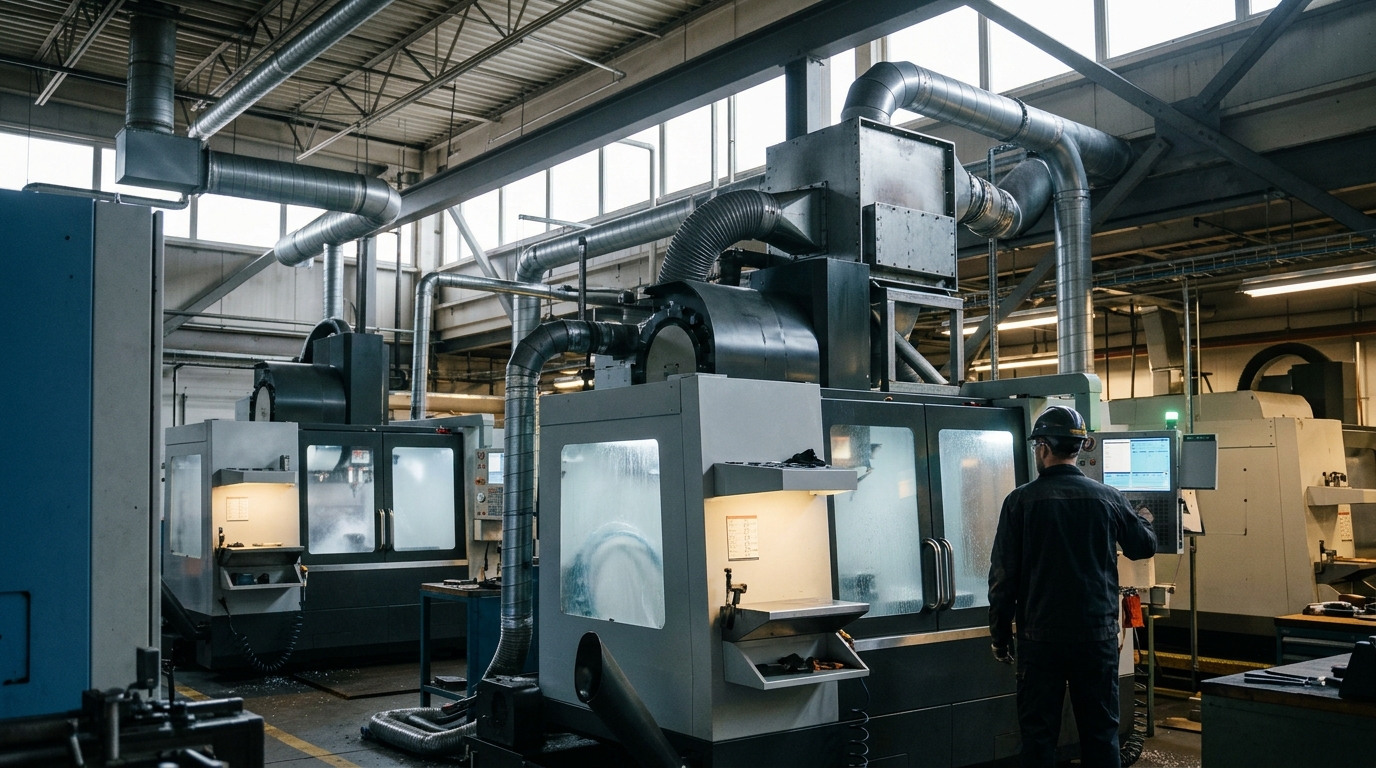
For most machine shops, a dedicated air filtration unit is the superior choice for protecting workers from coolant mist. Local exhaust ventilation (LEV) is effective for high-volume fume extraction but often lacks the fine filtration needed to capture submicron oil droplets. Aeroex designs source-capture systems that filter air at the machine, returning clean air to the shop floor. This approach reduces ductwork complexity while maintaining strict air quality standards for operators.
Understanding the Two Approaches
Industrial air quality management generally falls into two categories: recirculating filtration and exhaust ventilation. Understanding the difference is critical for worker safety.
Recirculating Air Filtration
Recirculating air filtration is a process where contaminated air is drawn from a source, passed through a series of filters to remove particulates, and then returned to the room. This method is ideal for capturing fine mist and smoke without losing conditioned air. It requires precise filter selection to handle liquid droplets and submicron particles.
Local Exhaust Ventilation (LEV)
Local exhaust ventilation is a system that captures contaminants at the source and discharges them outside the building through ductwork. LEV is commonly used for high-heat processes or toxic fumes. While it removes contaminants from the workspace, it does not filter the air for return. It also requires complex ducting and makes up air systems to maintain building pressure.
Option 1: Dedicated Air Filtration Units
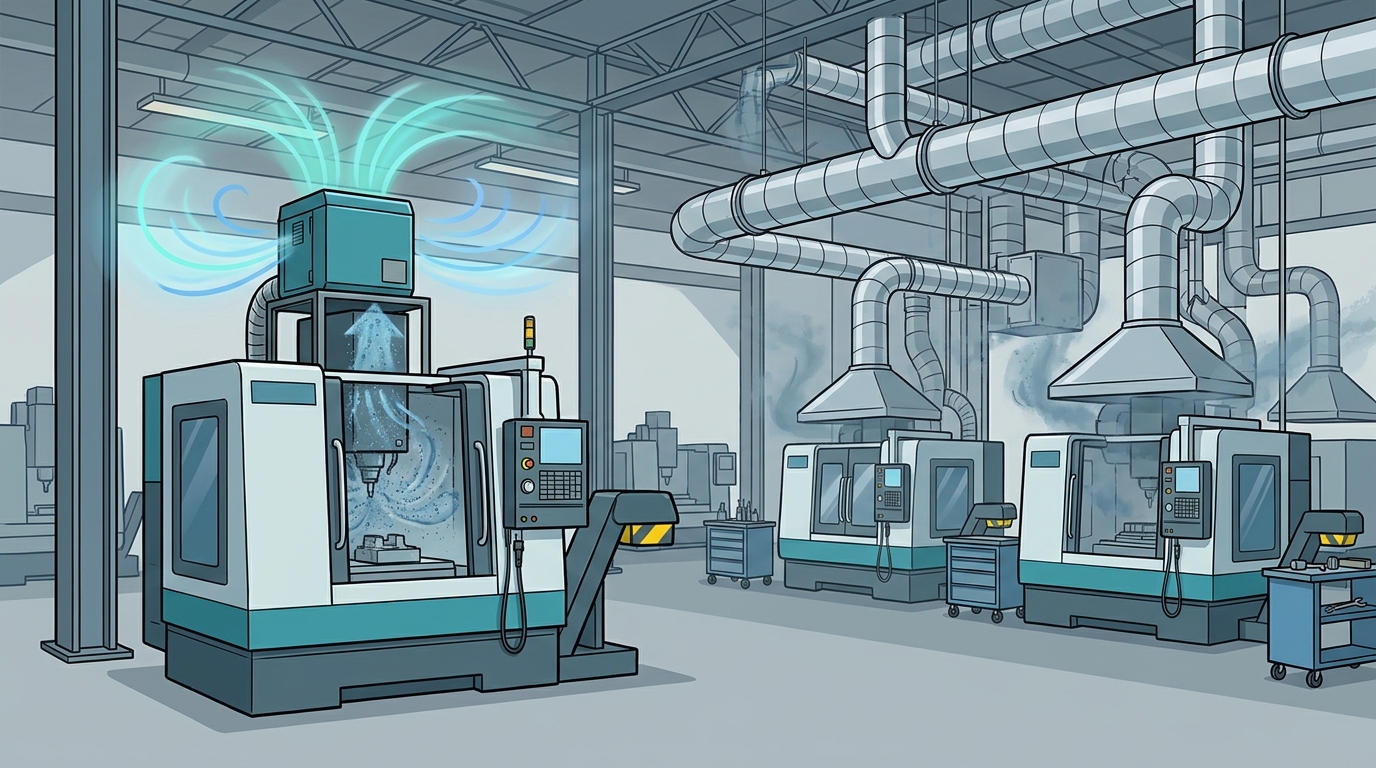
Dedicated filtration units, such as machine-mounted mist collectors, are designed specifically for metalworking environments. These systems use multi-stage filtration to handle the unique properties of coolant mist.
Strengths
These units offer high capture efficiency at the source. By mounting the collector directly on the machine, the system pulls air from inside the enclosure before mist escapes. This prevents the spread of contaminants to nearby operators. The filtration media, often including coalescers and HEPA filters, captures both liquid droplets and fine particulates. This results in cleaner air being returned to the shop, preserving HVAC efficiency.
Limits
Filtration units require regular maintenance. Filters must be inspected and replaced based on load and time. If the system is undersized for the machine's mist generation, it may struggle to maintain capture efficiency. However, modern units like the Aeroex Mist-Fit are engineered for direct mounting, simplifying installation and reducing the need for extensive ductwork.
Best For
This option is a strong fit for CNC machining centers, lathes, and grinding operations where fine mist is the primary concern. It is ideal for shops with limited floor space or those looking to avoid the cost of external ducting.
Option 2: Local Exhaust Ventilation (LEV)
LEV systems are robust and widely used in industrial settings. They rely on high-velocity airflow to capture contaminants and move them outside.
Strengths
LEV is highly effective for removing large volumes of heat and toxic fumes. It does not require filter changes in the same way recirculating systems do, as the air is discarded. This makes it a good choice for processes that generate significant smoke or chemical vapors that cannot be safely recirculated.
Limits
The primary limitation is the infrastructure required. LEV systems need ductwork, fans, and often make-up air units to replace the exhausted air. This increases installation cost and complexity. Furthermore, standard LEV ducts are not designed to filter fine mist. Without specialized filtration at the exhaust point, fine oil droplets may still be released or cause issues in the ductwork. It is less effective for capturing submicron particles compared to dedicated filtration units.
Best For
LEV is recommended for high-heat welding, brazing, or processes involving toxic chemical fumes where recirculation is not safe. It is less suitable for standard coolant mist control in enclosed CNC machines.
Comparison Table
| Criteria | Dedicated Air Filtration | Local Exhaust Ventilation |
|---|---|---|
| Primary Function | Capture and filter mist for return | Capture and exhaust air outside |
| Filter Maintenance | Regular filter replacement required | Minimal, duct cleaning only |
| Installation Complexity | Low, often direct-mount | High, requires ductwork and fans |
| Submicron Capture | High, using HEPA or coalescers | Low, unless specialized filters added |
| Energy Impact | Low, preserves conditioned air | High, requires make-up air |
| Best Application | CNC coolant mist, fine smoke | High-heat fumes, toxic vapors |
Choosing the Right System for Your Shop
Selecting the right protection method depends on your specific process and facility constraints.
Choose Air Filtration If
You are running CNC machines with coolant or oil mist. You want to minimize installation time and cost. You need to capture fine particles at the source without complex ducting. Aeroex systems, such as the Mist-Fit, are designed for this exact scenario, offering compact, direct-mount solutions that integrate seamlessly with machine enclosures.
Choose LEV If
Your process generates high volumes of heat or toxic fumes that cannot be filtered and returned. You already have an existing LEV infrastructure. You are dealing with processes like welding or chemical treatment where exhaust is mandatory. For these applications, an engineered solution may be required to integrate filtration with exhaust needs.
Frequently Asked Questions
Can I use a standard HVAC filter to capture coolant mist?
No, standard HVAC filters are not designed to capture liquid droplets or fine submicron mist. They will clog quickly and fail to protect workers. You need a dedicated mist collector with coalescing or HEPA filtration media.
Is local exhaust ventilation safer than recirculating filtration?
Both can be safe if designed correctly. LEV removes air from the building, while filtration cleans it for return. For coolant mist, filtration is often safer for operators because it captures fine particles at the source more effectively than standard LEV ducts.
How often do I need to change filters in a mist collector?
Filter life depends on the mist load and machine usage. In heavy machining environments, primary filters may need replacement every few months, while HEPA filters can last longer. Regular inspection is key to maintaining performance.
Can I switch from LEV to a filtration unit later?
Yes, many shops switch to dedicated filtration units to reduce energy costs and improve air quality. However, you must ensure the new system is sized correctly for your machines. Consulting with an expert can help determine the right airflow requirements.
Does Aeroex offer systems for both filtration and exhaust?
Aeroex specializes in recirculating filtration for mist and smoke. For complex applications requiring exhaust, they offer ARO-X modular systems that can be configured for specific process needs, including multi-stage filtration for demanding environments.
Conclusion
Protecting workers from coolant mist requires a targeted approach. For most CNC and metalworking operations, dedicated air filtration units offer the best balance of safety, efficiency, and ease of installation. They capture fine mist at the source and return clean air to the shop, preserving your HVAC investment. If your process involves high-heat fumes or toxic vapors, local exhaust ventilation may be necessary. Aeroex provides expert guidance to help you evaluate your specific machines and airflow needs. To find the right fit for your facility, contact our team for a consultation. Learn more: Contact Aeroex Emission Control.