
How Industrial Dust, Fume, and Mist Control Works in Manufacturing
Industrial dust, fume, and mist control works by capturing airborne contaminants at their source before they disperse into the shop air. Aeroex designs filtration systems that separate liquid droplets, submicron particles, and chemical vapors using multi-stage filtration. This process protects operator health, extends machine life, and ensures cleaner exhaust air. By understanding the specific physics of each contaminant type, manufacturers can select the right equipment for their unique processes.
Understanding the Three Main Contaminant Types
Manufacturing environments generate three distinct categories of airborne pollutants, each requiring a specific capture mechanism. Dust is defined as solid particulate matter, typically larger than 10 microns, generated by grinding, cutting, or sanding. Fume is defined as fine solid or liquid particles formed by the condensation of vapors, often resulting from welding, soldering, or high-heat processes. Mist is defined as a suspension of liquid droplets in air, commonly produced by coolant systems in CNC machining. Confusing these terms leads to incorrect equipment selection. For example, a system designed for large wood dust may not effectively capture fine coolant mist.
The physical size and state of the contaminant dictate the filtration method. Dust is often captured by mechanical barriers or cyclones. Fumes require high-efficiency filtration to catch submicron particles. Mists require coalescing filters that merge droplets into larger drops for drainage. Aeroex focuses primarily on mist and fume control, as these are the most common hazards in precision metalworking and machining shops.
The Critical Role of Source Capture
The most effective air control strategy is source capture, which removes contaminants at the point of generation. This approach prevents pollutants from entering the general shop environment. Source capture is defined as the localized extraction of air at the machine or process where the contaminant is created. In CNC machining, this often involves mounting a collector directly on the machine enclosure. This method requires significantly less airflow than room-level ventilation. It also prevents cross-contamination between different workstations.
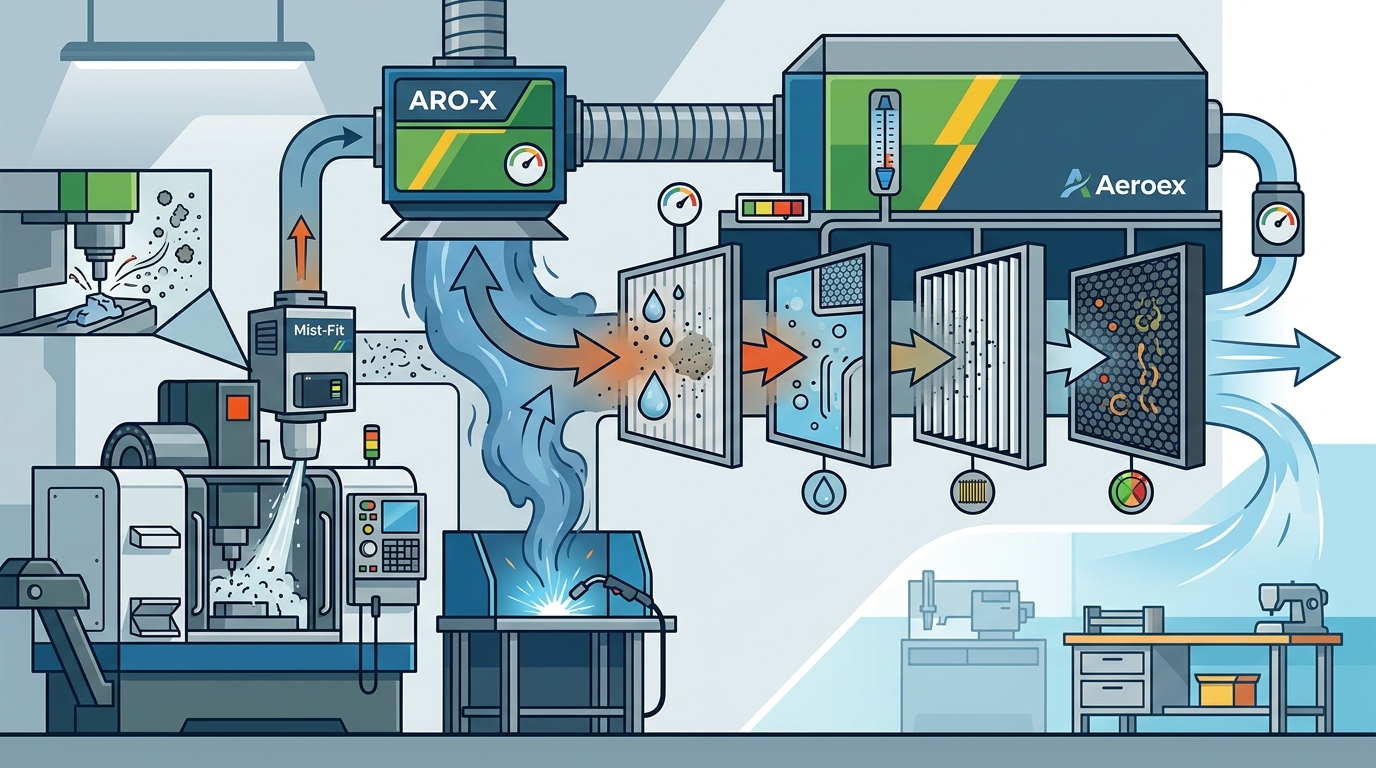
For compact machine layouts, direct-mount solutions are ideal. The Mist-Fit is designed for direct machine mounting, capturing coolant mist and oil mist at the source. This design eliminates the need for extensive ductwork. It is a strong fit for shops with limited floor space where individual machines need dedicated filtration. By capturing the mist before it escapes the enclosure, operators maintain clear visibility and reduce the risk of slipping on oily floors.
Multi-Stage Filtration Architecture
Modern industrial filtration systems use a multi-stage architecture to handle varying contaminant loads efficiently. A typical system begins with a pre-filter or coalescer stage. This stage captures the bulk of liquid droplets and large particles. The air then passes through a high-efficiency final stage, such as a HEPA filter. This final stage captures submicron particles and fine fumes. An optional carbon stage may be added to adsorb odors and volatile organic compounds (VOCs) from synthetic coolants.
This layered approach extends filter life and reduces maintenance costs. The pre-filter protects the expensive HEPA media from liquid saturation. Aeroex systems are engineered to handle straight oil, soluble oil emulsions, and synthetic coolants. The metalworking mist collectors utilize this progressive filtration to ensure ACGIH-grade air at the exhaust. This configuration is commonly used in high-speed machining environments where smoke and mist loads are high.
When to Use Engineered or Custom Systems
Not all applications fit a standard off-the-shelf unit. Complex environments often require engineered or custom industrial air filtration systems. Engineered solutions are defined as custom-tailored configurations designed for unique operating conditions, higher airflow requirements, or multiple machines. These systems may involve multi-stage filtration, specialized ducting, and custom mounting structures. They are recommended after an engineer reviews the specific machine type, airflow needs, and contaminant profile.
The ARO-X platform is a modular system designed for these more complex applications. It supports higher CFM ratings and can be configured for multi-machine setups. This is suitable for facilities with unique process contaminants, such as vapor or heavy smoke. For industries with strict hygiene requirements, such as food and beverage or chemical processing, stainless steel construction may be required. These systems are designed for washdown environments and corrosive conditions. Aeroex provides custom engineered solutions to address these specific challenges, ensuring the system meets the facility's unique operational demands.
Maintenance and Operational Efficiency
Effective air control is not just about installation; it is about consistent maintenance. Filters must be monitored and replaced to maintain system performance. Aeroex systems are designed for easy service access, minimizing downtime. Long filter life is a key feature, with some consumables lasting up to three years under normal conditions. Regular inspection of the pre-filter and coalescer stages ensures the final HEPA stage remains protected. This proactive approach reduces the total cost of ownership and ensures continuous air quality.
Operators should monitor airflow and pressure drop indicators to determine when filters need replacement. A sudden increase in pressure drop indicates a clogged filter. Ignoring this signal can lead to reduced airflow and potential motor strain. By integrating monitoring into daily routines, facilities can maintain optimal performance. This discipline is crucial for shops that rely on precise air quality for inspection or cleanroom-adjacent areas.
Key Takeaways
- Dust, fume, and mist are distinct contaminants requiring different capture and filtration methods.
- Source capture is the most efficient strategy, removing pollutants at the machine level.
- Multi-stage filtration uses pre-filters to protect high-efficiency HEPA media, extending filter life.
- Direct-mount collectors like the Mist-Fit are ideal for compact CNC layouts and limited floor space.
- Engineered systems like the ARO-X are necessary for complex, high-airflow, or multi-machine applications.
- Stainless steel construction is recommended for washdown, corrosive, or sanitary manufacturing environments.
- Regular maintenance and monitoring are essential for sustained air quality and equipment longevity.
Frequently Asked Questions
What is the difference between a mist collector and a dust collector?
Can one mist collector serve multiple machines?
Yes, but it depends on the total airflow requirement. A single high-capacity unit can serve multiple machines if the ducting is designed correctly. However, source capture at each machine is often more efficient and effective for maintaining air quality.
How often should I replace the filters in my mist collector?
Filter life depends on the contaminant load and operating hours. Pre-filters may need cleaning or replacement every few months. HEPA filters can last 1 to 3 years. Always monitor pressure drop indicators to determine the optimal replacement time.
Do I need a stainless steel mist collector?
You need stainless steel if your environment involves washdowns, corrosive chemicals, or strict sanitary requirements, such as in food and beverage production. For standard metalworking, a standard steel or aluminum housing is typically sufficient.
What is the role of a coalescer in a mist collector?
A coalescer is a filter media that causes small liquid droplets to merge into larger drops. These larger drops then drain back into the coolant sump or a collection tray. This stage is critical for removing the bulk of the liquid mist before it reaches the final filter.
How does Aeroex determine the right system for my shop?
Aeroex engineers review your machine type, coolant or oil type, airflow requirements, and mounting constraints. They may recommend a direct-mount unit like the Mist-Fit or a larger engineered system like the ARO-X based on this assessment.
Conclusion
Effective industrial air control relies on understanding the specific contaminants in your environment and selecting the appropriate capture and filtration technology. Whether you need a compact direct-mount unit for a single CNC machine or a complex engineered system for a multi-process facility, the principles of source capture and multi-stage filtration remain the same. Aeroex provides the expertise and products to help you achieve cleaner, safer air in your manufacturing environment. To discuss your specific application, for a tailored recommendation.